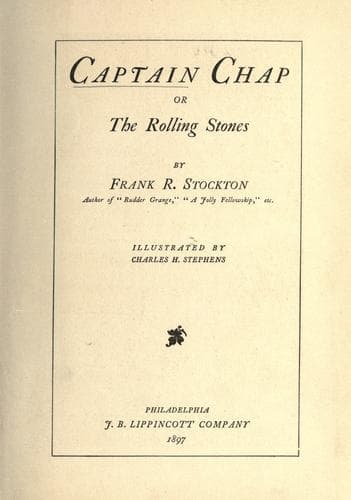
Captain Chap; or, The Rolling StonesStockton, Frank R.
General
Captain Chap; or, The Rolling Stones
Stockton, Frank R.
Florida -- Juvenile fiction; Teenage boys -- Juvenile fiction
Mr. Berkeley and Helen gazed at the long-legged boy, who had lost his
hat, and whose wet hair was sticking out in all directions, and they
burst into a laugh, in which Chap unhesitatingly joined.
“I expect the people must have wondered,” said Helen, “when they saw
me kiss such an awful-looking boy, but I was glad enough to get the
chance.”
“We could all see that,” said Mr. Berkeley; “and now I’ll take him down
below, and see what can be done for him.”
When Chap returned on deck, washed, combed, and dressed in a complete
suit, which had been loaned him by the purser, he was a well-dressed
and very gentlemanly-looking person. He did not see the countess that
day, as she did not come out from her state-room, but both he and
Mr. Berkeley made inquiries about her, and ascertained that she had
sustained no injury. But early the next morning, just before the boat
reached Sanford, Chap saw the countess on the deck. He went up to her,
but she looked at him coldly, and made no sign of recognition; but when
he spoke she opened her eyes.
“Are you the boy,” she exclaimed, “who stopped this steamboat for me?”
“And who afterward upset you in the river,” said Chap. “Yes; all of me
that isn’t purser of this boat is that boy.”
“But how did you come to run into us that way?” she asked.
Chap then explained how he thought he had been deserted by her, and
how, in his anxiety to overtake her, the accident had occurred.
“Well,” said she, when she had asserted that she had no idea of
treating him in that dreadful way, “you gave me a bad wetting and a
great fright, but you also helped and amused me very much, and, on the
whole, I am glad I met you.”
And she cordially shook hands with him.
“And now,” said Chap, as he rejoined Helen, “I’m done with the
aristocracy. It will do very well in certain quarters, but republican
institutions for me.”
Phil and Phœnix were on the pier when the Humphrey Giles arrived at
Sanford. They had received a telegram from John Robinson the day
before, sent from a point below on the river, telling them to wait at
Sanford for the Giles. They had wondered at the message, and would have
waited anyway, as there had been no chance for them to leave. But when
Chap, handsomely dressed, appeared on the gang-plank, conducting Helen
and Mr. Berkeley, Phil and Phœnix could not have been more astonished
had they seen an alligator stand up on its tail and sing “The Last Rose
of Summer.”
“What grates on me,” said Phil, laughing, as they sat on the porch of
Mr. Berkeley’s friend, the magistrate, “is to see Chap dressed up in
that fine fashion, while Phœnix and I are going about in these old
flannel clothes.”
“You forget,” said Chap, sitting up as straight as possible in his
chair; “that I am your captain, and, therefore, ought to be better
dressed. There is nothing that makes fellows knuckle down to rank and
dignity like appropriate costume.”
Public-domain text, read in full here on John Shaqi.
Reviews
Reviews
No reviews yet
Be the first to share your thoughts on this work.
Elsewhere in the archive
Join the Discussion
Join the discussion
Sign in to leave a comment or review.
Sign InorCreate an account