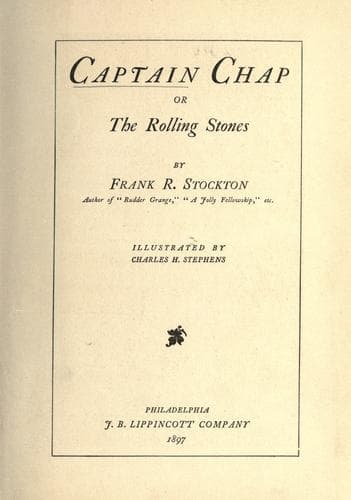
Captain Chap; or, The Rolling StonesStockton, Frank R.
General
Captain Chap; or, The Rolling Stones
Stockton, Frank R.
Florida -- Juvenile fiction; Teenage boys -- Juvenile fiction
“Of course, of course!” said Chap, with a grand wave of his hand. “The
captain must have his retainers; that is understood.”
The panther was put into the small boat, and Adam and Pitman rowed
ashore.
There the dead beast, after having been viewed with much delight by the
female Pitmans, was hung up to the limb of a tree and carefully skinned
by the two men.
When this job was finished Adam was glad to accept his friend’s offer
of a bed, the three boys being, by this time, fast asleep on their boat.
After breakfast, the next morning, Mr. Pitman asked Chap for his
address, and informed him that after he had properly prepared the skin
of the panther, he intended to send it to him.
To this Chap demurred, saying that Mr. Pitman ought to keep the skin
himself, and if he gave it to anybody, he ought to give it to some one
of the party who had had so long and weary a watch for it, and not to
the fellow who had gone to sleep and let the rest look out for the
approach of the beast.
But Mr. Pitman would listen to nothing of the kind, insisting that the
one who shot the panther should have the skin, and Phil, Phœnix, and
Adam agreeing that this was right, the matter was so settled.
As soon as possible our party set sail, with hearty expressions of good
will toward the Pitman family. The wind was fair, and, after a stop
that night at a place where nothing memorable occurred, they came early
the next afternoon in sight of Titusville.
On the way much attention had been paid to the health and comfort of
the little bears, and now that they were nearing the town, Adam gave
the tiller to Phil, and began to comb the soft hair and to generally
tidy up the little cubs. One of these animals had such a wise air that
Phil named him Solomon, whereupon Chap declared that his little sister
should be called the Queen of Sheba, giving a very broad sound to the
final “a,” in imitation of the backwoods accent.
“If there’s anybody in the town,” said Adam, “that wants ’em bad enough
to pay well for ’em, I’ll let ’em have ’em; but if no such person turns
up, I’ll lug the little creturs North as long as I’ve money enough to
buy milk.”
“Is this what that girl in the woods considered a big place?” exclaimed
Chap, as they sailed up to the town. “What would she say if she saw
the mighty metropolis of Boontown, not to mention New York, London, or
Pekin?”
Titusville was a settlement of about thirty or forty low wooden houses,
none of them far from the river-front, and all seeming to cluster
around and to depend upon an extensive one-story building, forming
three sides of a square, and fronted by large and well-kept grounds,
which stretched for two or three hundred feet to the river, where there
was a pretty little wharf. This house was the hotel, and the only
building of any size or pretension in the place.
As they came up to the wharf, they saw sitting on the extreme end
of the platform a small man, with sandy hair, short trousers, no
stockings, and cowhide shoes.
Public-domain text, read in full here on John Shaqi.
Reviews
Reviews
No reviews yet
Be the first to share your thoughts on this work.
Elsewhere in the archive
Join the Discussion
Join the discussion
Sign in to leave a comment or review.
Sign InorCreate an account