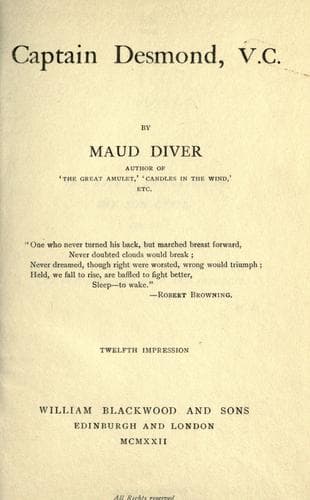
British -- India -- Fiction; India -- History -- British occupation, 1765-1947 -- Fiction
On that day Honor had gone over to Mrs Conolly's bungalow, there to
remain till Meredith's arrival; and in the two weeks that followed,
Desmond had seen little of her--or of any one save Paul. She had
helped him in disposing of Evelyn's personal belongings; and at his
earnest request, had accepted one or two of her trinkets, the
remainder being sent home to her mother. At his request also, Honor
had taken over charge of his piano while he was away; and if a touch
of constraint marked their parting, neither was aware of it in the
other.
By one sole distinction he had set her apart from the rest. To her,
and her only, he could and did speak of his wife; for the simple
reason that in her he recognised a love and a sorrow that matched his
own--a sorrow untainted by the lurking after thought, "Better so"; and
that tacit recognition had been for Honor the single ray of light in
her dark hour. Once, before parting, she had spoken of it to Paul, who
thenceforward knew his friend's aloofness for what it was--not the
mere reserve of the strong man in pain, but the old incurable loyalty
to his wife that had kept them all at arm's length in respect of her
while she lived.
So they two went forth together on their sorrowful pilgrimage; and,
once gone, there fell a curtain of silence between Desmond and those
he had left behind. Week after week, month after month, that silence
remained unbroken, though Olliver and his wife wrote and John Meredith
wrote also on his return; though they plied him with questions, with
news of the Regiment and Border politics, never a sight of his
handwriting came to cheer them. But for Paul's unfailing, if
discouraging bulletins, no word of him would have reached them at all.
Honor herself wrote twice, without avail; and thereafter accepted the
fiat of silence, gleaning what comfort she might from a steady
correspondence with Paul. It was not in her to guess how those
fortnightly letters, so frank in expression, so reserved in essence,
had upheld him through the darkest and most difficult months of his
life; months in which he could only stand aside and wait till the man
he loved, as Jonathan loved David, should come forth out of the house
of sorrow and take up the broken threads of life once more.
Meantime, with inexhaustible patience, he continued to try one place
after another, one distraction after another, with small result. It
was a costly prescription, and though Desmond imagined he contributed
his share, the chief of it was paid by his friend. During those first
months he read little, talked little, and rarely expressed a definite
wish. He would go anywhere, do anything in reason, so long as no
mental effort was required of him; but music--to Paul's utter
mystification--he decisively refused to hear. For the time being the
man's whole nature seemed awry, and there were moments when Paul's
heart contracted with dread of the worst.
Public-domain text, read in full here on John Shaqi.
Reviews
Reviews
No reviews yet
Be the first to share your thoughts on this work.
Elsewhere in the archive
Join the Discussion
Join the discussion
Sign in to leave a comment or review.
Sign InorCreate an account