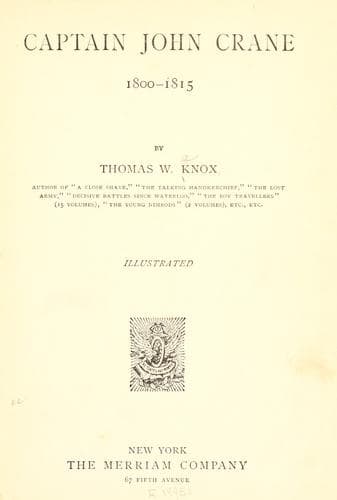
United States -- History -- War of 1812 -- Fiction
As soon as we had landed I wrote to the address which Captain Graham
had given me, telling of our arrival, and naming the hotel where we
were staying, which was one that had been suggested by our friend
Waghorn, of The Blue Anchor, at Plymouth. I sent the letter by a boy
who was attached to the hotel; and, two or three hours later, a note
came from the captain, telling me he had spoken for lodgings for us at
a house in Southsea, the southern suburb of Portsmouth, and advising me
to go there at once.
With the aid of the boy we moved to the lodgings, and found them very
comfortable, as well as reasonable in price. Captain Graham was living
in Southsea with his family, and the lodgings he had secured for us
were less than ten minutes' walk from his house. He invited me to
call there in the evening, and bring Haines with me. It was with much
difficulty that I persuaded the honest fellow to accompany me, as he
dreaded the tortures of sitting at table along with what he called
"fashionable folks," and even shrank from an hour upon a chair in a
parlor!
We went, and were most cordially received. On my comrade's account
I had agreed that the call should be a short one, and I took the
opportunity to whisper as much to the captain, while Haines was engaged
in conversation with Mrs. Graham and her daughters. Before we left the
house the captain asked if we were in need of anything which he could
supply. Happily I had all the money required for our present wants,
and so told him; whereupon he said he wished me to inform him promptly
whenever he could be of any service. Of course I promised to do so, and
then the subject was dropped.
I asked his advice as to our movements and conduct, now that we were
out on parole.
"I would advise" said he, "that you live here as quietly as you can, at
least for the present. The indications are that the war will not last
much longer; our government and people are getting tired of it, thanks
to the depredations of your privateers upon our commerce. We have
learned that American sailors can fight just as well as British ones;
and no man of sense in England disparages your navy at the present
time, as he was likely to do before the war broke out. The British loss
of merchantmen, of all classes, is fully twenty-three hundred, while
the American loss does not exceed five hundred. Fifty-six British war
vessels have been captured, with eight hundred and eighty cannon;
while twenty-five American war vessels with three hundred and fifty
guns have been taken by us. The game is a losing one to the British
side, and negotiations for peace are now going on!"
"And the sooner we have it the better for all concerned," I replied.
"No one will hail it more warmly than I shall."
"For one, I shall be very glad of it," said Mrs. Graham, "as I don't
like to be obliged to regard you and Mr. Haines as enemies."
Public-domain text, read in full here on John Shaqi.
Reviews
Reviews
No reviews yet
Be the first to share your thoughts on this work.
Elsewhere in the archive
Join the Discussion
Join the discussion
Sign in to leave a comment or review.
Sign InorCreate an account