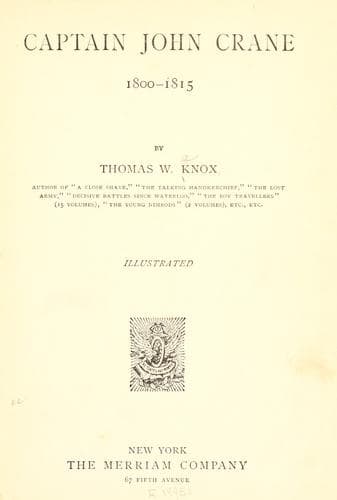
United States -- History -- War of 1812 -- Fiction
In the latter part of the voyage I had frequent conversations with Miss
Violet, who had a good many questions to ask about the United States,
and the way the people lived there. She asked about the cities, and I
was obliged to say that I knew nothing about them. I told her I had
been in only one large city, Boston, and remained there only a very
short time.
"I suppose," said Miss Violet, "that you came directly from the country
to go on board the Washington, did you not?"
"Yes, miss," I answered; "my friend David and I walked from our homes
in New Hampshire to Boston; and the very morning we arrived there we
signed the ship's articles and went on board the Washington."
"Then you don't know what a great city is. I hope sometime you will be
able to see London and go all over it. You will have to stay some time
to do it," she added with a laugh, "as London is the greatest city in
the world."
I replied that I believed it was, and probably my sailor's life would
take me there some time.
She was very much interested in the account I gave her of country life
in New Hampshire,--of the deep snows in winter; the distance between
houses; the long distance we had to go to church on Sunday; and the
schools we attended in winter. I told her all about our farm-life,--how
we worked in the fields in planting-time, haying-season, and harvest,
and what we had on our tables for our meals at different seasons of
the year. Every time I had a conversation with her, her younger sister
listened for a while with almost as much interest as Miss Violet did,
but after a time she grew listless and turned away. When she did so I
usually thought I had talked quite enough, and so I changed or dropped
the subject, and then proceeded about my duties.
I had been relieved from standing watch, as the reader knows, but I
slept in the forecastle just as I had before being appointed cabin-boy.
My companions joked me a good deal about my new associations, and said
they expected I wouldn't condescend to look at them any more. It was
amusing enough at first; but after a time it grew wearisome, and I
intimated as much to Haines.
Thereupon Haines passed the word that the sport at my expense might
as well come to an end. Most of the watch acted upon his suggestion
and gave me no more annoyance. Others kept it up for a while, until
they received a more vigorous reminder, and one of them persisted in
it until he had a little game of fisticuffs with Haines. The row was
all over in a few minutes, as all the rest of the crew took Haines's
part. At the suggestion of one of them the combatants shook hands and
forgave each other, and from this time on I was no longer the subject
of ridicule.
Public-domain text, read in full here on John Shaqi.
Reviews
Reviews
No reviews yet
Be the first to share your thoughts on this work.
Elsewhere in the archive
Join the Discussion
Join the discussion
Sign in to leave a comment or review.
Sign InorCreate an account