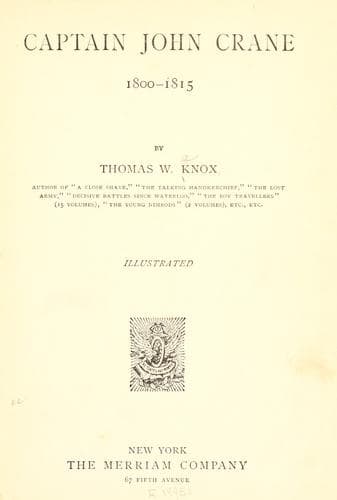
United States -- History -- War of 1812 -- Fiction
We found some letters awaiting us at the owners' office, one of them
of quite recent date. Everybody in both the families was well; and
in every letter they told us how much we were missed. We were half
inclined to make a visit to Pembroke, but finally concluded not to do
so, as the journey would be expensive for us in case we traveled by
stage-coach, and fatiguing if we made it on foot. We decided to remain
in Boston and look out for berths on the first good ship that was
leaving port. We thought it quite possible that we might sail on the
Washington; but after calling two or three times at the ship, and also
at her owners' office, we concluded that she would be delayed too long
in port to suit us.
The third day after our arrival, we heard of a fine new ship, the
"Aurora," which was up for China. Her cargo was nearly all on board,
and she would sail in a few days. We went on board of her; and then
we went to her agents and found that what we had heard was true.
Bill Haines and Joe Herne accompanied us, or rather we accompanied
them, as it was Haines who first heard of the Aurora, and advised
our visiting her. The four of us had stuck together, going to the
same boarding-house to live, and going about together on sight-seeing
excursions.
The result of our investigation was that we signed articles for the
Aurora; and when she sailed out of Boston on her way to China we trod
her deck with a good deal of satisfaction. None of us cared to go to
the Mediterranean again and run the risk of becoming an Algerine slave;
and, furthermore, we thought it was a good chance to see the world by
taking the course we did.
At that time not many American ships had visited China, the trade of
the United States being principally with the West Indies, the west
coast of Africa, the Mediterranean Sea, and the ports of Great Britain
and Europe. The United States had about one and a quarter million tons
of commercial shipping, and it was evident that in the course of time a
voyage to China would be almost as common as a trip to any of the West
Indian ports.
Our voyage to China was not very eventful; we had no severe gales at
all on the way out, though we had several heavy blows which might have
troubled a landsman if he had been caught in one of them a day or two
after going to sea for the first time. When we reached the region of
the equator we were caught in the calm belt, which is well known to
sailors, and had an exasperating delay under the rays of a tropical
sun that beat down pitilessly upon us, while we lay with sails hanging
loose from the yards, and with scarcely a sign of motion anywhere. When
we crossed the equator, the greenhorns (all those who had never before
been in the southern hemisphere) were treated to a visit by Neptune.
This is an invariable custom on shipboard, and sometimes the victims
are severely handled.
Public-domain text, read in full here on John Shaqi.
Reviews
Reviews
No reviews yet
Be the first to share your thoughts on this work.
Elsewhere in the archive
Join the Discussion
Join the discussion
Sign in to leave a comment or review.
Sign InorCreate an account