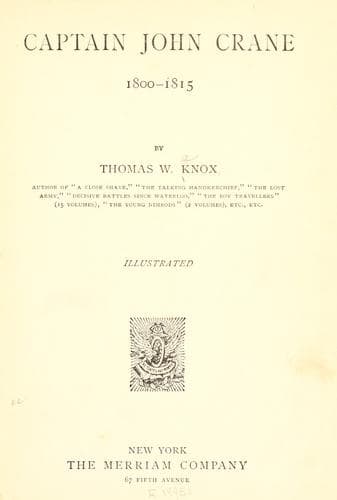
United States -- History -- War of 1812 -- Fiction
I must not forget to say that the most profound respect was paid to the
remains of Captain Lawrence when the ships reached Halifax, and also
to those of Lieutenant Ludlow, who died there within a week after their
arrival. The garrison furnished a funeral party from the Sixty-fourth
Regiment, and the navy also furnished one. At the hour appointed for
the funeral the body was taken in a boat from the Chesapeake to the
King's Wharf, where it was received by the military under the commander
of the garrison. The officers of the Chesapeake followed the body as
mourners, and the officers of the British navy were also in attendance.
There was great depression in the United States over the loss of the
Chesapeake, as the almost uninterrupted success of the navy thus far
had made the Americans believe that it was invincible. The same idea
was beginning to prevail among the British; hence the great elation of
the latter, and the corresponding depression of the former. Happily,
the feeling of depression among the Americans soon passed away, as
it was seen that all the circumstances were very unfavorable to the
Chesapeake, and it was not likely that such a misfortune would occur
again.
Having followed the Chesapeake through her unlucky career, which ended
with her capture by the Shannon, we will now go back to where Haines
began the story of his experience as a man-of-war's man.
The embargo of 1807 was then in force, but there was a great pressure
on the government for its withdrawal, and on the 1st of March, 1809, it
was repealed. Meantime I went on another voyage to China as second mate
of the Aurora, the ship on which I had formerly sailed as a foremast
hand. Haines accompanied me, and we had no experiences out of the
ordinary run on the entire voyage.
Yes, we had one experience that I ought to mention; we were overhauled
by a British man-of-war in the South Atlantic Ocean, and compelled to
submit to a search for British deserters. Several times during the
voyage we saw men-of-war, and ran away from them, but this one caught
us when we were becalmed, having sailed close to us during the night,
while we were enveloped in a fog. When the fog lifted the wind had gone
down, and we lay helpless, within easy range of her cannon.
She sent a boat on board, and the officer who came in it was inclined
to take away two of our crew, alleging that they were Englishmen. They
showed their protection papers, which set forth that they were American
citizens. The lieutenant was about to disregard these when our captain
told him that, if he took those men away, the case would be reported to
the American government, and he added, "I will spend every dollar that
I possess to see that justice is secured. These men are Americans, and
I have known them both from their boyhood. If you take them from this
ship you will find that they are not without friends."
Public-domain text, read in full here on John Shaqi.
Reviews
Reviews
No reviews yet
Be the first to share your thoughts on this work.
Elsewhere in the archive
Join the Discussion
Join the discussion
Sign in to leave a comment or review.
Sign InorCreate an account