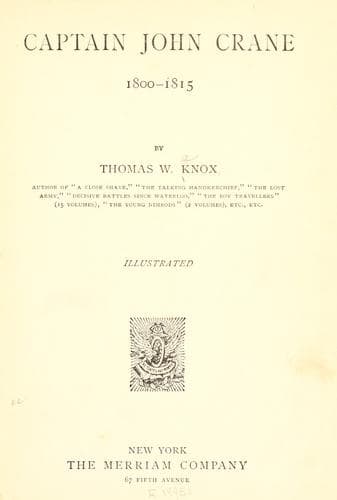
United States -- History -- War of 1812 -- Fiction
Great Britain always claimed that she was entitled to take from
American vessels on the high seas any of her own subjects voluntarily
serving on American craft, but she constantly gave as a reason for
not discharging from her service any American citizens, that they
had voluntarily engaged in it. She used to take her own subjects from
the American service, although they had been settled and married and
naturalized in the United States; but at the same time she constantly
refused to release from her ships American seamen who had been pressed
into it, whenever she could give as a reason that they were settled and
married in her dominions. In other words, when marriage or residence
could be pleaded in her favor, she availed herself of the plea. When
marriage, residence, and naturalization were against her, she paid no
respect whatever to the plea.
I made several coasting voyages, and also another voyage to China;
the last time as first mate of a ship as large as the Aurora. When I
came home from this voyage to China, in the latter part of 1811, the
owners of the ship expressed themselves as entirely satisfied with my
services, and said they should give me command of a ship as soon as
possible. The reader can imagine my elation at this news. I wanted to
go away somewhere alone and call myself captain, just to see how it
would sound; and, as good luck would have it, on that very day when
I was notified of my promotion, my friend David arrived in port and
received the same information. We congratulated each other, and then
proceeded to find Haines and Herne, and tell them of the good news.
Not only did we tell them of our promotion, but we notified each of
them that we wanted him to go with us whenever we went to sea, Haines
on my ship and Herne on David's--no, stop a moment! Mr. Haines on
Captain Crane's ship, and Mr. Herne on Captain Taylor's, as we intended
to make officers of them.
My promotion to the rank of captain was not of as much importance as
it might have been, owing to circumstances which were quite out of my
control. American commerce was paralyzed by the state of affairs then
prevailing. British insults to our flag continued; British war-vessels
were numerous on our coast; and the impressment of American sailors
under the pretense that they were deserters from the British service
were of almost daily occurrence. Things were rapidly growing from bad
to worse, and war between the two countries seemed inevitable.
I was a captain without a command, as the vessel to which I had been
assigned was lying in port with no prospect of employment. This
continued for some time, when one day I was summoned to report at
once at the office of my employers. I realized the importance of the
summons when I learned that four messengers had been sent out to look
for me, with instructions to say that not a moment was to be lost in my
responding to the call.
Public-domain text, read in full here on John Shaqi.
Reviews
Reviews
No reviews yet
Be the first to share your thoughts on this work.
Elsewhere in the archive
Join the Discussion
Join the discussion
Sign in to leave a comment or review.
Sign InorCreate an account