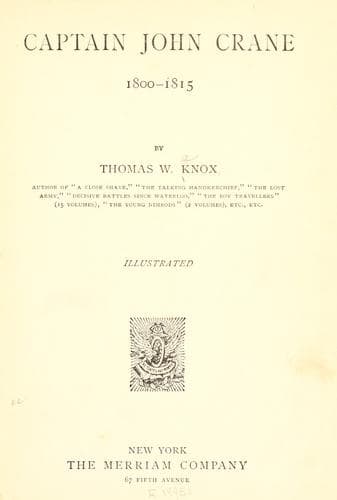
United States -- History -- War of 1812 -- Fiction
The Revolution of 1776 began the struggle; but the object was
not accomplished till the War of 1812 had put an end to British
interference with our commerce, and the impressment of our citizens
into British service. Protests and complaints were without effect;
not only were adopted citizens of the United States taken to serve
on British ships or in the army, but many native-born Americans were
impressed to do duty under a flag which was not their own. Great
Britain claimed that no subject could become an alien; "once a Briton
always a Briton" was her motto. Our laws gave equal protection to the
native and the adopted citizen, and therefore we stood by the Briton
who chose to become a citizen with us, and had taken the necessary
steps in that direction.
Less than an hour after affixing his signature to the bill of Congress
declaring war with Great Britain, the President signed the commission
which allowed David Taylor and John Crane, commanding the Hyacinth and
the Marguerite, to prey upon British commerce. The commissions were
brought by the messengers that bore the news of the declaration of war,
and they were not long in reaching us after their arrival at Paulus
Hook.
All our stores were on board, and all our arms and powder. The guns
were in their places; the extra carpenters who had been retained on
board under pay, in order to prevent their telling what we were about,
were discharged and put ashore; and the complement of the crew was
taken on at the anchorage to which we dropped down off the Battery.
Everything was done so quickly that we were at sea before the news of
the declaration of war was generally known in New York.
I steered away to the eastward, while David took a southerly course.
Before we separated we made a small wager as to who should take the
first prize. He was in search of vessels plying between England and the
West Indies; while I wanted those whose course was to or from Halifax.
At daylight, on my third morning at sea, a sail was reported on the
starboard bow. I scanned her through my glass, concluded she was what I
wanted, and ordered all sail to be cracked on in her direction.
The stranger did not change her course at all. She was a full-rigged
ship, much larger than the Marguerite, and evidently a merchantman. We
hung out the American flag, but she did not respond to the courtesy;
it was manifest that her captain did not consider it worth his while
to display his colors to such an insignificant craft as an American
schooner.
We could out-sail and out-maneuver the stranger. By my orders we ranged
up abreast of her so as to have the weather gauge, and when within
hailing distance, I called out,--
"What ship is that?"
For fully a minute there was no answer, and then came the words,--
"What ship is that?"
This was a bit of impudence that angered and, at the same time, amused
me. I held my temper and responded,--
"The American privateer, Marguerite. Heave to, or I'll fire into you!"
Public-domain text, read in full here on John Shaqi.
Reviews
Reviews
No reviews yet
Be the first to share your thoughts on this work.
Elsewhere in the archive
Join the Discussion
Join the discussion
Sign in to leave a comment or review.
Sign InorCreate an account