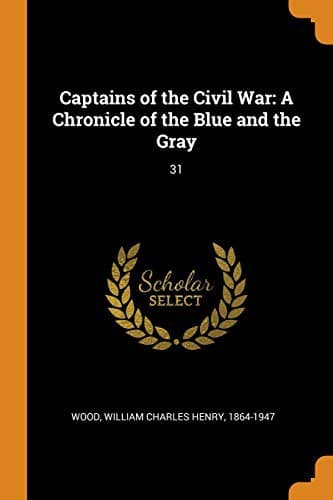
Captains of the Civil War: A Chronicle of the Blue and the GrayWood, William
History
Captains of the Civil War: A Chronicle of the Blue and the Gray
Wood, William
United States -- History -- Civil War, 1861-1865 -- Biography; United States -- History -- Civil War, 1861-1865 -- Campaigns
On the very day of the assassination Sherman had written to Johnston
offering the same terms Grant had given Lee and Lincoln had most
heartily approved. Three days later, on the seventeenth, just as
Sherman was entering the train for his meeting with Johnston, the
operator handed him a telegram announcing the assassination. Enjoining
secrecy till he returned, Sherman took the telegram with him and
showed it to Johnston, whom he watched intently. "The perspiration
came out on his forehead," Sherman wrote, "and he did not attempt to
conceal his distress. He denounced the act as a disgrace to the age
and hoped I did not charge it to the Confederate Government. I told
him I could not believe that he or General Lee or the officers of the
Confederate army could possibly be privy to acts of assassination."
When Sherman got back to Raleigh he published the news in general
orders, and experienced the supreme satisfaction of finding that
not one man in all that mournful army had to be restrained from
a single act of revenge.
After much misunderstanding with Washington now in lesser hands,
the surrender of Johnston's and the other Confederate armies was
effected. Each body of troops laid down its arms and quietly dispersed.
One day the bugles called, the camp fires burned, and comrades
were together in the ranks. The next, like morning mists, they
disappeared, thenceforth to be remembered and admired only as the
heroes of a hopeless cause.
It was a very different scene through which their rivals marched
into lasting fame with all the pride, pomp, and circumstance of war.
On the twenty-third and twenty-fourth of May, in perfect weather,
and in the stirring presence of a loyal, vast, enthusiastic throng,
the Union armies were reviewed in Washington. For over six full
hours each day the troops marched past--the very flower of those
who had come back victorious. The route was flagged from end to
end with Stars and Stripes, and banked with friends of each and
every regiment there. Between these banks, and to the sound of
thrilling martial music, the long blue column flowed--a living
stream of men whose bayonets made its surface flash like burnished
silver under the glorious sun.
Then, when the pageantry was finished, and the volunteers that formed
the vast bulk of those magnificent Federal armies had again become
American civilians in thought and word and deed, these steadfast
men, whose arms had saved the Union in the field, were first in
peace as they had been in war: first in the reconstruction of their
country's interrupted life, first in recognizing all that was best
in the splendid fighters with whom they had crossed swords, and
first--incomparably first--in keeping one and indivisible the reunited
home land of both North and South.
BIBLIOGRAPHICAL NOTE
Public-domain text, read in full here on John Shaqi.
Reviews
Reviews
No reviews yet
Be the first to share your thoughts on this work.
Elsewhere in the archive
Join the Discussion
Join the discussion
Sign in to leave a comment or review.
Sign InorCreate an account