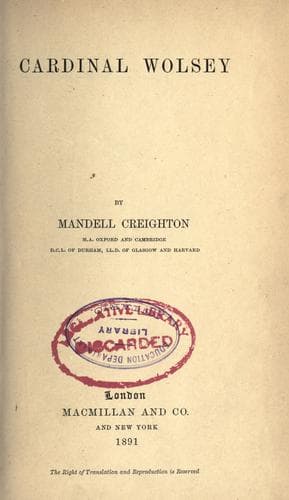
"No statesman of such eminence ever died less lamented," is Dr. Brewer's
remark on Wolsey's death. Indeed, the king had forgotten his old
servant; his enemies rejoiced to be rid of a possible rival; the men
whom he had trained in politics were busy in seeking their own
advancement, which was not to be promoted by tears for a fallen
minister; the people had never loved him, and were indifferent about one
who was no longer powerful. In a time of universal uncertainty every one
was speculating on the future, and saw that the future was not to be
determined by Wolsey or by Wolsey's ideas. Not without reason has the
story of Wolsey's fall passed into a parable of the heartlessness of the
world.
For Wolsey lived for the world as few men have ever done; not for the
larger world of intellectual thought or spiritual aspiration, but for
the actual, immediate world of affairs. He limited himself to its
problems, but within its limits he took a wider and juster view of the
problems of his time than any English statesman has ever done. For
politics in the largest sense, comprising all the relations of the
nation at home and abroad, Wolsey had a capacity which amounted to
genius, and it is doubtful if this can be said of any other Englishman.
There have been many capable administrators, many excellent organisers,
many who bravely faced the difficulties of their time, many who
advocated particular reforms and achieved definite results. But Wolsey
aimed at doing all these things together and more. Taking England as he
found her, he aimed at developing all her latent possibilities, and
leading Europe to follow in her train. In this project there was nothing
chimerical or fantastic, for Wolsey's mind was eminently practical.
Starting from the existing condition of affairs, he made England for a
time the centre of European politics, and gave her an influence far
higher than she could claim on material grounds. Moreover, his
far-reaching schemes abroad did not interfere with strict attention to
the details of England's interests. His foreign policy was to promote
English trade, facilitate the union of Scotland, keep peace at small
expense, prepare the way for internal re-organisation, and secure the
right of dealing judiciously with ecclesiastical reform. Wolsey's plans
all hung together. However absorbed he might be in a particular point it
was only part of a great design, and he used each advantage which he
gained as a means of strengthening England's position for some future
undertaking. He had a clear view of the future as a whole; he knew not
only what he wished to make of England but of Europe as well. He never
worked at a question from one motive only; what failed for one purpose
was made useful for another; his resources were not bounded by the
immediate result.
Public-domain text, read in full here on John Shaqi.
Reviews
Reviews
No reviews yet
Be the first to share your thoughts on this work.
Elsewhere in the archive
Join the Discussion
Join the discussion
Sign in to leave a comment or review.
Sign InorCreate an account