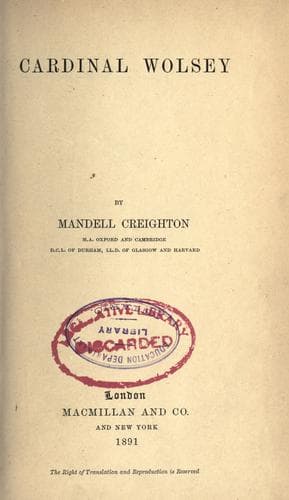
The fact that Wolsey was a statesman rather than an ecclesiastic gave
him a clear view of the direction which a conservative reformation
should pursue. He saw that the Church was too wealthy and too powerful
for the work which it was actually doing. The wealth and power of the
Church were a heritage from a former age, in which the care for the
higher interests of society fell entirely into the hands of the Church
because the State was rude and barbarous, and had no machinery save for
the discharge of rudimentary duties. Bishops were the only officials who
could curb the lawlessness of feudal lords; the clergy were the only
refuge from local tyranny; monks were the only landlords who cleared the
forests, drained the marshes, and taught the pursuits of peace;
monastery schools educated the sons of peasants, and the universities
gave young men of ability a career. All the humanitarian duties of
society were discharged by the Church, and the Church had grown in
wealth and importance because of its readiness to discharge them. But as
the State grew stronger, and as the power of Parliament increased, it
was natural that duties which had once been delegated should be assumed
by the community at large. It was equally natural that institutions
which had once been useful should outlast their usefulness and be
regarded with a jealous eye. By the end of the reign of Edward I.
England had been provided with as many monastic institutions as it
needed, and the character of monasticism began to decline. Benefactions
for social purposes from that time forward were mainly devoted to
colleges, hospitals, and schools. The fact that so many great churchmen
were royal ministers shows how the energy of the Church was placed at
the disposal of the State and was by it absorbed. The Church possessed
revenues, and a staff of officials which were too large for the time, in
which it was not the only worker in the field of social welfare. It
possessed rights and privileges which were necessary for its protection
in days of anarchy and lawlessness, but which were invidious in days of
more settled government. Moreover, the tenure of so much land by
ecclesiastical corporations like monasteries, was viewed with jealousy
in a time when commercial competition was becoming a dominant motive in
a society which had ceased to be mainly warlike.
From this point of view Wolsey was prepared for gradual changes in the
position of the Church; but he did not wish those changes to be
revolutionary, nor did he wish them to be made by the power of the
State. He knew the real weakness of the Church and the practical
omnipotence of the king; but he hoped to unite the interests of the
Crown and of the Church by his own personal influence and by his
position as the trusted minister of king and Pope alike.
Public-domain text, read in full here on John Shaqi.
Reviews
Reviews
No reviews yet
Be the first to share your thoughts on this work.
Elsewhere in the archive
Join the Discussion
Join the discussion
Sign in to leave a comment or review.
Sign InorCreate an account