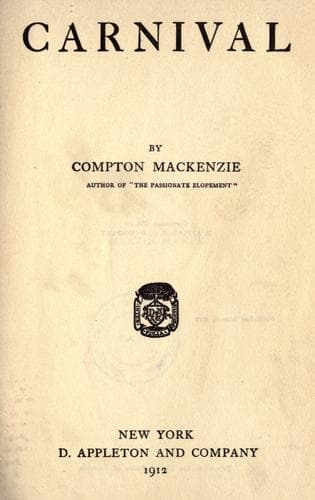
Bildungsromans; Man-woman relationships -- Fiction; Scotland -- Social life and customs -- Fiction
Miss Constance Ragstead was a woman of about forty, possessing much of
the remote and chastened beauty that was evident in Miss Bailey. She,
too, was pale, not unhealthily, but with the impression of having lived
long in a rarefied atmosphere. Virginity has its fires, and Miss
Ragstead was an inheritor of the spirit which animated Saint Theresa and
Mary Magdalene of Pazzi. Her social schemes were crowned with aureoles,
her plans were lapped by tenuous gold flames. She was a mystic of
humanity, one who from the contemplation of mortality in its individual
aspirations, had arrived at the acknowledgment of man as a perfect idea
and was able from his virtues to create her theogony. This woman's
presence implied the purification of ceaseless effort. Activity as
expressed by her was a sacrament. It conveyed the isolated solemnity of
a force that does not depend for its reality on human conceptions or
practical altruism. Her activity was a moral radium never consumed by
the expenditure of its energy; it was dynamic whether it effected little
or much. When she recalled the factory in which for a year she had
worked as a hand, the enterprise was hallowed with the romance of a
saint's pilgrimage. When she spoke of her green garden, where June had
healed the hearts of many young women, she seemed like an eremite in
whose consolation was absolute peace. Her voice was modulated with those
half-tones that thrushes ring upon the evening air; and since they were
produced suddenly with no hint of premeditation, the feeblest listener
was at some time inevitably waylaid.
It was not astonishing Jenny should find herself caught in the melodious
twilight of the oration, should find that the craning audience was less
important than the speaker. She came to believe that Mona Lisa's smile
was kindlier. She began to take in some of the rhetoric of the
peroration:
"I wish I could persuade you that, if our cause is a worthy cause, it
must exist and endure through the sanity of its adherents. It must never
depend upon the trivial eccentricities of a few. I want to see the
average woman fired with zeal to make the best of herself. I do not want
us to be contemptuously put aside as exceptions. Nor am I anxious to
recruit our strength from the discontented, the disappointed and the
disillusioned. Let us do away with the reproach that we voice a
minority's opinion. Let us preserve the grace and magic of womanhood, so
that with the spiritual power of virginity, the physical grandeur of
motherhood, in a devoted phalanx huge as the army of Darius, we may
achieve our purpose."
Here the speaker paused and, as if afraid she might be deemed to offer
counsels of pusillanimity, broke forth more passionately:
Public-domain text, read in full here on John Shaqi.
Reviews
Reviews
No reviews yet
Be the first to share your thoughts on this work.
Elsewhere in the archive
Join the Discussion
Join the discussion
Sign in to leave a comment or review.
Sign InorCreate an account