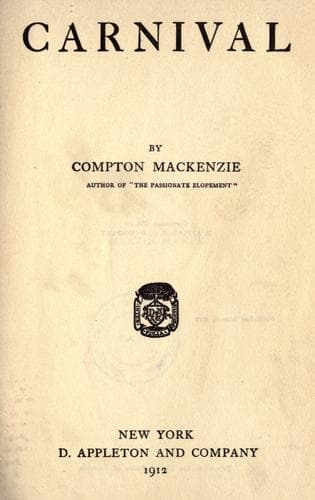
Bildungsromans; Man-woman relationships -- Fiction; Scotland -- Social life and customs -- Fiction
Jenny debated the notion of leaving the Orient and applying all her mind
to keeping house; but it was too late for her temperament to inure
itself to domesticity without the spur of something sharper than mere
pecuniary advantage. Perhaps it would be better to give up the house in
Hagworth Street and take a smaller one, where, on the joint earnings of
herself and her father, he and the two sisters could live in tolerable
comfort. Perhaps she might even accept the risk of setting up house with
May alone. But thirty shillings a week was not a large sum for two
girls, one of whom must be well dressed and able to hold her own in
company where dress counted for a good deal. The more she thought of it,
the more impossible did it seem to give up the theater. Those few days
of absence proved how intimately her existence was wrapped up in the
certainty of an evening's employment. As the time had drawn on for going
down to the Orient, she had become very restless in the quiet of home.
However much she might scoff at it, there was wonderful comfort in the
assurance of a cheerful evening of dressing-room gossip. Besides, there
was always the chance of an interesting stranger in front or of suddenly
being called upon to play a noticeable part, though that pleasure grew
more and more insipid all the time. There was, however, still a certain
agreeable reflection in the consciousness of looking pretty and knowing
that a few eyes every night remarked her face and figure. And even if
all these consolations of theatrical existence failed, there was a very
great satisfaction in making up and leaving, as it were, one's own
discontented body behind.
For a time everything went on as usual and nobody put forward any
definite proposal involving a change either of residence or mode of
life. Jenny began to think she was doomed to settle down into perpetual
dullness and never again to be launched desperately on a passionate
adventure. She was beginning to be aware how easy it was for a woman to
belie the temperament of her youth with a common-place maturity. By the
end of the summer their father had already advanced so far on the road
to moral and financial disintegration as to make it evident to Jenny and
May that they must fend for themselves. One lodger, an old clerk in a
Moorgate firm of solicitors, had already left, and the other, a
Cornishman working in a dairy, would soon be carrying the result of his
commercial experience back to his native land. Neither of the girls
liked the prospect of new lodgers and were nervous of affording shelter
to possible thieves or murderers. Nor did May in particular enjoy the
supervision of the servant or wrestling with the slabs of unbaked dough
which heralded her culinary essays. So at last she and Jenny decided the
house was altogether too large and that they must give notice to quit.
"And aren't I to give no opinion on the subject of my own house?" asked
their father indignantly.
Public-domain text, read in full here on John Shaqi.
Reviews
Reviews
No reviews yet
Be the first to share your thoughts on this work.
Elsewhere in the archive
Join the Discussion
Join the discussion
Sign in to leave a comment or review.
Sign InorCreate an account