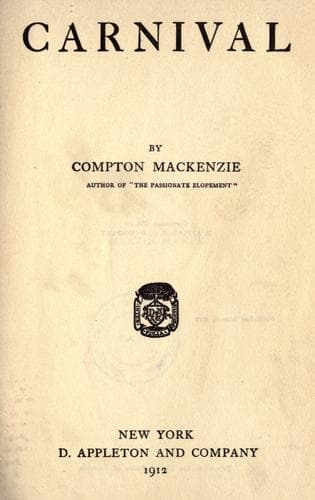
Bildungsromans; Man-woman relationships -- Fiction; Scotland -- Social life and customs -- Fiction
It was like action in a dream to reach down from the rack various
parcels and boxes, to fold up cloaks and collect umbrellas. Jenny
watched from the window for the twinkle of town lights heralding their
stopping-place, but without any preliminary illumination the train
pulled up at Nantivet Road.
"Here we are," shouted Trewhella, and as the girls stood with frightened
eyes in the dull and tremulous light of the platform, he seemed fresh
from a triumphant abduction. The luggage lay stacked in a gray pile with
ghostly uncertain outlines. The train, wearing no longer any familiar
look of London, puffed slowly on to some farther exile, its sombre bulk
checkered with golden squares, the engine flying a pennant of sparks as
it swung round into a cutting whence the sound of its emerging died away
on the darkness in a hollow moan. The stillness of the deep November
night was now profound, merely broken by the rasp of a trunk across the
platform and the punctuated stamping of a horse's hoof on the wet road.
"That's Carver," said Trewhella, as the three of them, their tickets
delivered to a shadowy figure, walked in the direction of the sound.
"Carver?" repeated Jenny.
"My old mare."
The lamps of the farm cart dazzled the vision as they stood watching the
luggage piled up behind. To the girls the cart seemed enormous; the mare
of mammoth size. The small boy who had driven to meet them looked like a
gnome perched upon the towering vehicle, and by his smallness confirmed
the impression of hugeness.
"Well, boy Thomas," said his master in greeting.
"Mr. Trewhella!"
"Here's missus come down."
"Mrs. Trewhella!" said the boy in shy welcome.
"And her sister, Miss Raeburn," added the farmer.
Jenny looked wistfully at May as if she envied her the introduction with
its commemoration of Islington.
"Now, come," said Zachary, "leave me give 'ee a hand up."
He lifted May and set her down on the seat. Then he turned to his wife.
"Come, my dear, leave me put 'ee up."
"I'd rather get in by myself," she answered.
But Trewhella caught her in his arms and, with a kiss, deposited her
beside May. Thomas was stowed away among the luggage at the back; the
farmer himself got in, shook up Carver, and with a good night to the
porter set out with his bride to Bochyn.
The darkness was immense: the loneliness supreme. At first the road lay
through an open stretch of flat boggy grassland, where stagnant pools of
water glimmered with the light of the cart lamps as the vehicle shambled
by. After a mile or so they dipped down between high hedges and
overarching trees that gave more response to their lights than the open
country, whose incommensurable blackness swallowed up their jigging,
feeble illumination.
"It smells like the inside of a flower-shop, doesn't it?" said May. "You
know, sort of bathroom smell. It must be glorious in the daytime."
"Yes, 'tis grand in summer time, sure enough," Trewhella agreed.
Public-domain text, read in full here on John Shaqi.
Reviews
Reviews
No reviews yet
Be the first to share your thoughts on this work.
Elsewhere in the archive
Join the Discussion
Join the discussion
Sign in to leave a comment or review.
Sign InorCreate an account