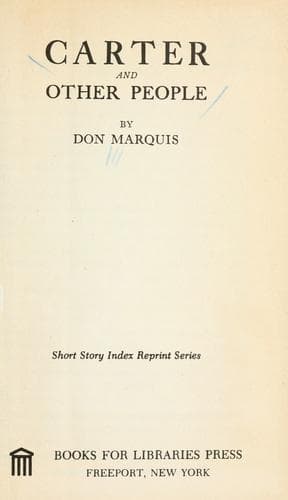
American fiction -- 20th century; Short stories, American
“And then began a strange period in my life. Shortly after this episode
came a partial triumph of the reform element in my city; the grafters
were ousted, and I found myself with more than a local reputation, and
thrust into an office. My life was now even more of a public matter than
before. We entertained largely. We were always in the public eye. Before
our guests and in public we were always all that should be. But when
the occasion was past, we would drop the mask, turn from each other with
dumb faces, and go each our severed ways.
“For a year this sort of life kept up. I still worked; but now I worked
to forget. When I allowed myself to think of her at all, it was always
as of some one who was dead. Or so I told myself, over and over again,
until I believed it.
“One day there was a close election. I was the successful candidate. I
was to go to Congress. All evening and far into the night my wife and
I played our parts well. But when the last congratulation had been
received, and the last speech made, and the last friend had gone, and
we were alone with each other once more, she turned to me with a look
something like the one she had met me with on that summer evening a year
before.
“'I want to speak with you,' she said.
“'Yes?'
“They were the first words we had exchanged in that year, when not
compelled by the necessities.
“'What do you wish to speak about?' I asked her.
“'You know,' she said, briefly. And I did know. There was little use
trying to deny it.
“'Why have you asked me no questions?' she said.
“I would have made another attempt to pass the situation over without
going into it, but I saw that that would be impossible. She had reached
the place where she must speak. I read all this in her face. And looking
at her closely with the first candid glance I had given her in that
year, I saw that she had changed greatly, but she was still beautiful.
“'I did not choose to open the subject with you,' I said; 'I thought
that you would explain when you could stand it no longer. Evidently that
time has come. You were to me like a dead person. If the dead have any
messages for me, they must bring them to me unsolicited. It was not my
place to hunt among the tombs.'
“'No,' she said, 'let us be honest, since it is the last talk we may
ever have together. Let us be frank with each other, and with ourselves.
I was not like a dead person to you. The dead are dead, and I am not.
You asked me no questions because you disdained me so. You despised
me so--and it was sweet to you to make me feel the full weight of your
scorn through this silence. It was better than killing me. Is that not
the real reason?'
“'Yes,' I admitted, 'that is it. That is the truth.' “'Listen,' she
said, 'it would surprise you--would it not--to learn that I still love
you--that I have loved you all along--that you are the only man I have
ever really loved--that I love you now? All that is incredible to you,
is it not?'
Public-domain text, read in full here on John Shaqi.
Reviews
Reviews
No reviews yet
Be the first to share your thoughts on this work.
Elsewhere in the archive
Join the Discussion
Join the discussion
Sign in to leave a comment or review.
Sign InorCreate an account