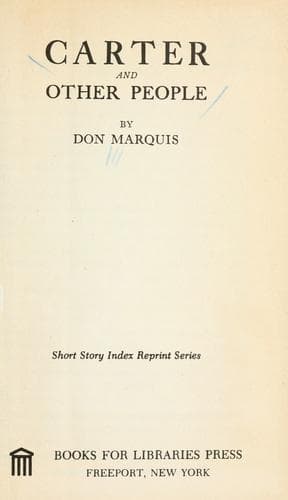
American fiction -- 20th century; Short stories, American
When he talked of the Zend-Avesta, when he spoke of the Vedantic
writings, when he touched upon the Shinto worship of the Nipponese, when
he descanted upon the likeness of the Christian teachings to the tenets
of Buddhism, when he revealed the secrets of the Yogi philosophy, when
he hinted his knowledge of the priestly craft of older Egypt and of
later Eleusis, his feminine followers thrilled in their seats as a
garden of flowers that is breathed upon by a Summer wind--they vibrated
to his words and his manner and his restrained fervor with a faint
rustling of silken garments and a delicate fragrance of perfume.
Men were not, as a rule, so enthusiastic concerning Dr. Eustace Beaulieu
and his cult; there were few of them at his lectures, there were few of
them enrolled in the classes where he inducted his followers into the
more subtle phases of ethics, where he led them to the higher planes
of occultism, for a monetary consideration; few of them submitted
themselves to him for the psychic healing that was one of his major
claims to fame. And this scarred and bearded stranger, who limped, was
one of the very few men who had ever intimated a desire to bare his soul
to Dr. Beaulieu, to tell his story and receive spiritual ministration,
in the manner of the confessional. These confessionals, after the public
lectures, had been recently introduced by Dr. Beaulieu, and they were
giving him, he felt, a firmer grip upon his flock--his disciples, he did
not hesitate to call them.
“I repeat,” said the penitent--if he was a repentant man, indeed--“no
bachelor can know what love really is. He cannot conceive of what the
daily habit of association with a woman who seems made for him, and for
him alone, may mean to a man. My love for my wife was almost worship.
She was my wife indeed, I told myself, and she it was for whom I worked.
“For I did work, worked well and unselfishly. Every man must have
some work. Some do it from necessity, but I did it because I loved
the work--and the woman--and thus I gained a double reward. I was a
politician, and something more. I think I may say that I was a patriot,
too. The inheritor of wealth and position, I undertook to clear the city
in which I lived, and which my forefathers had helped to build, of
the ring of grafters who were making the name of the town a byword
throughout the nation. The details of that long and hard strife are not
pertinent. I fought with something more than boldness and determination;
I fought with a joy in every struggle, because I fought for something
more than the world knew. The world could not see that my inspiration
was in my home; that in the hours of battle my blood sang joyously with
the thought of--her! Was it any wonder that I worked well?
Public-domain text, read in full here on John Shaqi.
Reviews
Reviews
No reviews yet
Be the first to share your thoughts on this work.
Elsewhere in the archive
Join the Discussion
Join the discussion
Sign in to leave a comment or review.
Sign InorCreate an account