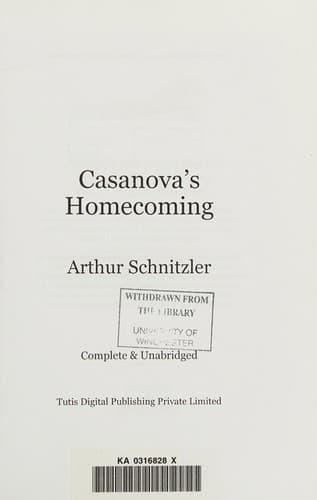
Adventure stories; Biographical fiction; Casanova, Giacomo, 1725-1798 -- Fiction; Europe -- Fiction; Sex customs -- Fiction
continued to avoid any unsuitable innuendo or display of vanity. His
audience might have imagined themselves listening to the story of a
Parsifal rather than to that of a Casanova, the dangerous seducer and
half-savage adventurer.
He told them of the fair Unknown who had travelled with him for weeks
disguised as a man in officer’s uniform, and one morning had suddenly
disappeared from his side; of the daughter of the gentleman cobbler in
Madrid who, in the intervals between their embraces, had studiously
endeavored to make a good Catholic of him; of Lia, the lovely Jewess of
Turin, who had a better seat on horseback than any princess; of Manon
Balletti, sweet and innocent, the only woman he had almost married; of
the singer whom he had hissed in Warsaw because of her bad performance,
whereupon he had had to fight a duel with her lover, General Branitzky,
and had been compelled to flee the city; of the wicked woman Charpillon,
who had made such an abject fool of him in London; of the night when he
crossed the lagoons to Murano on the way to his adored nun, the night
when he nearly lost his life in a storm; of Croce the gamester, who,
after losing a fortune at Spa, had taken a tearful farewell of Casanova
upon the high-road, and had set off on his way to St. Petersburg, just
as he was, wearing silk stockings and a coat of apple-green satin, and
carrying nothing but a walking cane.
He told of actresses, singers, dressmakers, countesses, dancers,
chambermaids; of gamblers, officers, princes, envoys, financiers,
musicians, and adventurers. So carried away was he by the rediscovered
charm of his own past, so completely did the triumph of these splendid
though irrecoverable experiences eclipse the consciousness of the
shadows that encompassed his present, that he was on the point of
telling the story of a pale but pretty girl who in a twilit church at
Mantua had confided her love troubles to him--absolutely forgetting that
this same girl, sixteen years older, now sat at the table before him
as the wife of his friend Olivo--when the maid came in to say that the
carriage was waiting. Instantly, with his incomparable talent for doing
the right thing, Casanova rose to bid adieu. He again pressed Olivo, who
was too much affected to speak, to bring wife and children to visit him
in Venice. Having embraced his friend, he approached Amalia with
intent to embrace her also, but she held out her hand and he kissed it
affectionately.
When he turned to Marcolina, she said: “You ought to write down
everything you told us this evening, Chevalier, and a great deal more,
just as you have penned the story of your flight from The Leads.”
“Do you really mean that, Marcolina?” he enquired, with the shyness of a
young author.
She smiled with gentle mockery, saying: “I fancy such a book might prove
far more entertaining than your polemic against Voltaire.”
Public-domain text, read in full here on John Shaqi.
Reviews
Reviews
No reviews yet
Be the first to share your thoughts on this work.
Elsewhere in the archive
Join the Discussion
Join the discussion
Sign in to leave a comment or review.
Sign InorCreate an account