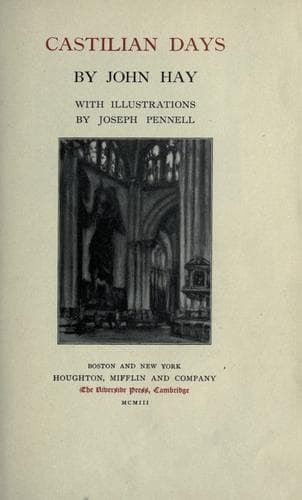
Spain -- Description and travel; Spain -- Social life and customs
We sat on the terrace benches to enjoy the light and graceful lines of
the building, the delicately ornate door, the unique drapery of iron
chains which the freed Christians hung here when delivered from the
hands of the Moors. A lovely child, with pensive blue eyes fringed with
long lashes, and the slow sweet smile of a Madonna, sat near us and sang
to a soft, monotonous air a war-song of the Carlists. Her beauty soon
attracted the artistic eyes of La Senora, and we learned she was named
Francisca, and her baby brother, whose flaxen head lay heavily on her
shoulder, was called Jesus Mary. She asked, Would we like to go into the
church? She knew the sacristan and would go for him. She ran away like a
fawn, the tow head of little Jesus tumbling dangerously about. She
reappeared in a moment; she had disposed of mi nino, as she called it,
and had found the sacristan. This personage was rather disappointing. A
sacristan should be aged and mouldy, clothed in black of a decent
shabbiness. This was a Toledan swell in a velvet shooting-jacket, and
yellow peg-top trousers. However, he had the wit to confine himself to
turning keys, and so we gradually recovered from the shock of the
shooting-jacket.
The church forms one great nave, divided into four vaults enriched with
wonderful stone lace-work. A superb frieze surrounds the entire nave,
bearing in great Gothic letters an inscription narrating the foundation
of the church. Everywhere the arms of Castile and Arragon, and the
wedded ciphers of the Catholic kings. Statues of heralds start
unexpectedly out from the face of the pillars. Fine as the church is, we
cannot linger here long. The glory of San Juan is its cloisters. It may
challenge the world to show anything so fine in the latest bloom and
last development of Gothic art. One of the galleries is in ruins,--a sad
witness of the brutality of armies. But the three others are enough to
show how much of beauty was possible in that final age of pure Gothic
building. The arches bear a double garland of leaves, of flowers, and of
fruits, and among them are ramping and writhing and playing every figure
of bird or beast or monster that man has seen or poet imagined. There
are no two arches alike, and yet a most beautiful harmony pervades them
all. In some the leaves are in profile, in others delicately spread upon
the graceful columns and every vein displayed. I saw one window where a
stone monkey sat reading his prayers, gowned and cowled,--an odd caprice
of the tired sculptor. There is in this infinite variety of detail a
delight that ends in something like fatigue. You cannot help feeling
that this was naturally and logically the end of Gothic art. It had run
its course. There was nothing left but this feverish quest of variety.
It was in danger, after having gained such divine heights of invention,
of degenerating into prettinesses and affectation.
Public-domain text, read in full here on John Shaqi.
Reviews
Reviews
No reviews yet
Be the first to share your thoughts on this work.
Elsewhere in the archive
Join the Discussion
Join the discussion
Sign in to leave a comment or review.
Sign InorCreate an account