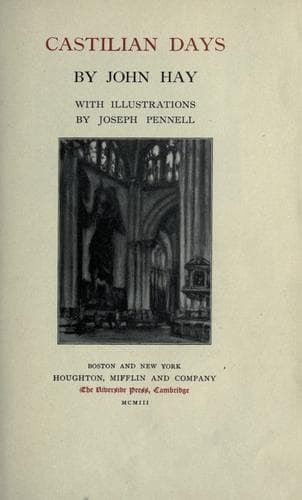
Spain -- Description and travel; Spain -- Social life and customs
Our little maid was too young to have sympathy for kings or servant
girls who die for love. She was a pretty picture as she sat there, her
blue eyes and Madonna face turned to the rosy west, singing in her sweet
child's voice her fierce little song of sedition and war:--
"Arriba los valientes!
Abajo tirania!
Pronto llegara el dia
De la Restauracion.
Carlistas a caballo!
Soldados en Campana!
Viva el Rey de Espana,
Don Carlos de Borbon!"
I cannot enumerate the churches of Toledo,--you find them in every
street and by-way. In the palmy days of the absolute theocracy this
narrow space contained more than a hundred churches and chapels. The
province was gnawed by the cancer of sixteen monasteries of monks and
twice as many convents of nuns, all crowded within these city walls.
Fully one half the ground of the city was covered by religious buildings
and mortmain property. In that age, when money meant ten times what it
signifies now, the rent-roll of the Church in Toledo was forty millions
of reals. There are even yet portions of the town where you find nothing
but churches and convents. The grass grows green in the silent streets.
You hear nothing but the chime of bells and the faint echoes of masses.
You see on every side bolted doors and barred windows, and, gliding over
the mossy pavements, the stealthy-stepping, long-robed priests.
I will only mention two more churches, and both of these converts from
heathendom; both of them dedicated to San Cristo, for in the democracy
of the calendar the Saviour is merely a saint, and reduced to the level
of the rest. One is the old pretorian temple of the Romans, which was
converted by King Sizebuto into a Christian church in the seventh
century. It is a curious structure in brick and mortar, with an apsis
and an odd arrangement of round arches sunken in the outer wall and
still deeper pointed ones. It is famed as the resting-place of Saints
Ildefonso and Leocadia, whom we have met before. The statue of the
latter stands over the door graceful and pensive enough for a heathen
muse. The little cloisters leading to the church are burial vaults. On
one side lie the canonical dead and on the other the laity, with bright
marble tablets and gilt inscriptions. In the court outside I noticed a
flat stone marked _Ossuarium._ The sacristan told me this covered the
pit where the nameless dead reposed, and when the genteel people in the
gilt marble vaults neglected to pay their annual rent, they were taken
out and tumbled in to moulder with the common clay.
Public-domain text, read in full here on John Shaqi.
Reviews
Reviews
No reviews yet
Be the first to share your thoughts on this work.
Elsewhere in the archive
Join the Discussion
Join the discussion
Sign in to leave a comment or review.
Sign InorCreate an account