Spain -- Description and travel; Spain -- Social life and customs
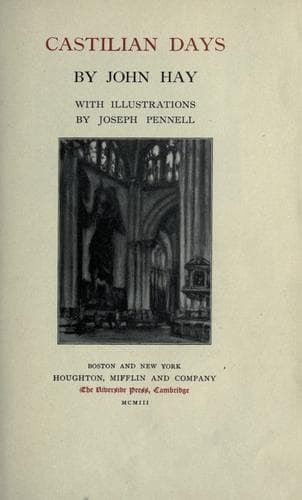
Entering the vestibule of the church, and looking up, you observe with a
sort of horror that the ceiling is of massive granite and flat. The
sacristan has a story that when Philip saw this ceiling, which forms the
floor of the high choir, he remonstrated against it as too audacious,
and insisted on a strong pillar being built to support it. The architect
complied, but when Philip came to see the improvement he burst into
lamentation, as the enormous column destroyed the effect of the great
altar. The canny architect, who had built the pillar of pasteboard,
removed it with a touch, and his majesty was comforted. Walking forward
to the edge of this shadowy vestibule, you recognize the skill and taste
which presided at this unique and intelligent arrangement of the choir.
If left, as usual, in the body of the church, it would have seriously
impaired that solemn and simple grandeur which distinguishes this above
all other temples. There is nothing to break the effect of the three
great naves, divided by immense square-clustered columns, and surmounted
by the vast dome that rises with all the easy majesty of a mountain more
than three hundred feet from the decent black and white pavement. I know
of nothing so simple and so imposing as this royal chapel, built purely
for the glory of God and with no thought of mercy or consolation for
human infirmity. The frescos of Luca Giordano show the attempt of a
later and degenerate age to enliven with form and color the sombre
dignity of this faultless pile. But there is something in the blue and
vapory pictures which shows that even the unabashed Luca was not free
from the impressive influence of the Escorial.
A flight of veined marble steps leads to the beautiful retable of the
high altar. The screen, over ninety feet high, cost the Milanese Trezzo
seven years of labor. The pictures illustrative of the life of our Lord
are by Tibaldi and Zuccaro. The gilt bronze tabernacle of Trezzo and
Herrera, which has been likened with the doors of the Baptistery of
Florence as worthy to figure in the architecture of heaven, no longer
exists. It furnished a half hour's amusement to the soldiers of France.
On either side of the high altar are the oratories of the royal family,
and above them are the kneeling effigies of Charles, with his wife,
daughter, and sisters, and Philip with his successive harem of wives.
One of the few luxuries this fierce bigot allowed himself was that of a
new widowhood every few years. There are forty other altars with
pictures good and bad. The best are by the wonderful deaf-mute,
Navarrete, of Logrono, and by Sanchez Coello, the favorite of Philip.
Public-domain text, read in full here on John Shaqi.
Reviews
Reviews
No reviews yet
Be the first to share your thoughts on this work.
Elsewhere in the archive
Join the Discussion
Join the discussion
Sign in to leave a comment or review.
Sign InorCreate an account