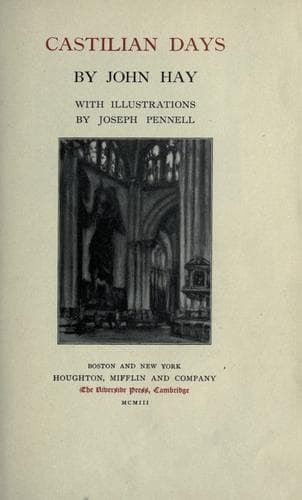
Spain -- Description and travel; Spain -- Social life and customs
dwelling almost exclusively upon the story of his sufferings, they
excited the emotional nature of the ignorant, and left their intellects
untouched and dormant. They aimed to arouse their sympathies, and when
that was done, to turn their natural resentment against those whom the
Church considered dangerous. To the inflamed and excited worshippers, a
heretic was the enemy of the crucified Saviour, a Jew was his murderer,
a Moor was his reviler. A Protestant wore to their bloodshot eyes the
semblance of the torturer who had mocked and scourged the meek Redeemer,
who had crowned his guileless head with thorns, who had pierced and
slain him. The rack, the gibbet, and the stake were not enough to glut
the pious hate this priestly trickery inspired. It was not enough that
the doubter's life should go out in the blaze of the crackling fagots,
but it must be loaded in eternity with the curses of the faithful.
Is there not food for earnest thought in the fact that faith in Christ,
which led the Puritans across the sea to found the purest social and
political system which the wit of man has yet evolved from the tangled
problems of time, has dragged this great Spanish people down to a depth
of hopeless apathy, from which it may take long years of civil tumult to
raise them? May we not find the explanation of this strange phenomenon
in the contrast of Catholic unity with Protestant diversity? "Thou that
killest the prophets!"--the system to which this apostrophe can be
applied is doomed. And it matters little who the prophets may be.
THE CRADLE AND THE GRAVE OF CERVANTES
In Rembrandt Peale's picture of the Court of Death a cadaverous shape
lies for judgment at the foot of the throne, touching at either
extremity the waters of Lethe. There is something similar in the history
of the greatest of Spanish writers. No man knew, for more than a century
after the death of Cervantes, the place of his birth and burial. About a
hundred years ago the investigations of Rios and Pellicer established
the claim of Alcala de Henares to be his native city; and last year the
researches of the Spanish Academy have proved conclusively that he is
buried in the Convent of the Trinitarians in Madrid. But the precise
spot where he was born is only indicated by vague tradition; and the
shadowy conjecture that has so long hallowed the chapel and cloisters of
the Calle Cantarranas has never settled upon any one slab of their
pavement.
It is, however, only the beginning and the end of this most chivalrous
and genial apparition of the sixteenth century that is concealed from
our view. We know where he was christened and where he died. So that
there are sufficiently authentic shrines in Alcala and Madrid to satisfy
the most sceptical pilgrims.
Public-domain text, read in full here on John Shaqi.
Reviews
Reviews
No reviews yet
Be the first to share your thoughts on this work.
Elsewhere in the archive
Join the Discussion
Join the discussion
Sign in to leave a comment or review.
Sign InorCreate an account