Spain -- Description and travel; Spain -- Social life and customs
It is hard to conceive that this was once a great capital with a
population of two hundred thousand souls. You can easily walk from one
end of the city to the other in less than half an hour, and the houses
that remain seem comfortably filled by eighteen thousand inhabitants.
But in this narrow space once swarmed that enormous and busy multitude.
The city was walled about by powerful stone ramparts, which yet stand in
all their massy perfection. So there could have been no suburbs. This
great aggregation of humanity lived and toiled on the crests and in the
wrinkles of the seven hills we see to-day. How important were the
industries of the earlier days we can guess from the single fact that
John of Padilla, when he rose in defence of municipal liberty in the
time of Charles V., drew in one day from the teeming workshops twenty
thousand fighting men. He met the usual fate of all Spanish patriots,
shameful and cruel death. His palace was razed to the ground. Successive
governments, in shifting fever-fits of liberalism and absolutism, have
set up and pulled down his statue. But his memory is loved and honored,
and the example of this noblest of the comuneros impresses powerfully
to-day the ardent young minds of the new Spain.
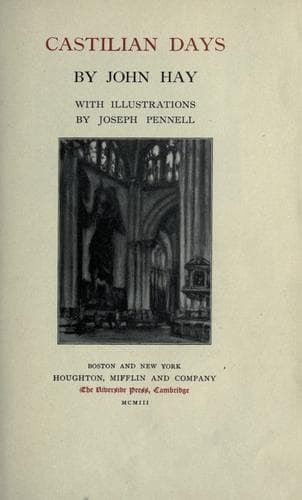
Your first walk is of course to the Cathedral, the Primate Church of the
kingdom. Besides its ecclesiastical importance, it is well worthy of
notice in itself. It is one of the purest specimens of Gothic
architecture in existence, and is kept in an admirable state of
preservation. Its situation is not the most favorable. It is approached
by a network of descending streets, all narrow and winding, as streets
were always built under the intelligent rule of the Moors. They
preferred to be cool in summer and sheltered in winter, rather than to
lay out great deserts of boulevards, the haunts of sunstroke and
pneumonia. The site of the Cathedral was chosen from strategic reasons
by St. Eugene, who built there his first Episcopal Church. The Moors
made a mosque of it when they conquered Castile, and the fastidious
piety of St. Ferdinand would not permit him to worship in a shrine thus
profaned. He tore down the old church and laid, in 1227, the
foundations of this magnificent structure, which was two centuries after
his death in building. There is, however, great unity of purpose and
execution in this Cathedral, due doubtless to the fact that the
architect Perez gave fifty years of his long life to the superintendence
of the early work. Inside and outside it is marked by a grave and
harmonious majesty. The great western facade is enriched with three
splendid portals,--the side ones called the doors of Hell and Judgment;
and the central a beautiful ogival arch divided into two smaller ones,
and adorned with a lavish profusion of delicately sculptured figures of
saints and prophets; on the chaste and severe cornice above, a group of
spirited busts represents the Last Supper. There are five other doors to
Public-domain text, read in full here on John Shaqi.
Reviews
Reviews
No reviews yet
Be the first to share your thoughts on this work.
Elsewhere in the archive
Join the Discussion
Join the discussion
Sign in to leave a comment or review.
Sign InorCreate an account