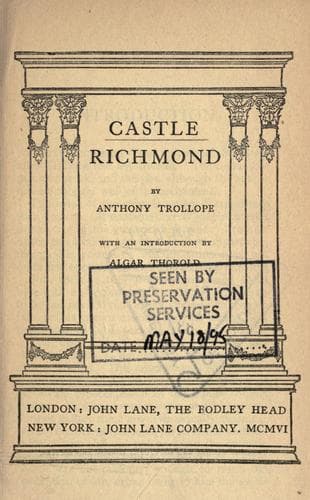
Great Britain -- Fiction; Historical fiction; Ireland -- Fiction; Love stories; Social classes -- Fiction
She had ardently desired to caution her son in this respect,--to
guard him, if possible, against future disappointment and future
sorrow. But she could not do so without obtaining in some sort her
husband's assent to her doing so. She resolved that she would talk it
over with Sir Thomas. But the subject was one so full of pain, and he
was so ill, and therefore she had put it off.
And now she saw that the injury was done. Nevertheless, she said
nothing either to Emmeline or to Herbert. If the injury were done,
what good could now result from talking? She doubtless would hear it
all soon enough. So she sat still, watching them.
On the following morning Sir Thomas did not come out to breakfast.
Herbert went into his room quite early, as was always his custom; and
as he left it for the breakfast-parlour he said, "Father, I should
like to speak to you just now about something of importance."
"Something of importance, Herbert; what is it? Anything wrong?" For
Sir Thomas was nervous, and easily frightened.
"Oh dear, no; nothing is wrong. It is nothing that will annoy you; at
least I think not. But it will keep till after breakfast. I will come
in again the moment breakfast is over." And so saying he left the
room with a light step.
In the breakfast-parlour it seemed to him as though everybody was
conscious of some important fact. His mother's kiss was peculiarly
solemn and full of solicitude; Aunt Letty smirked as though she was
aware of something--something over and above the great Protestant
tenets which usually supported her; and Mary had no joke to fling at
him.
"Emmeline," he whispered, "you have told."
"No, indeed," she replied. But what mattered it? Everybody would know
now in a few minutes. So he ate his breakfast, and then returned to
Sir Thomas.
"Father," said he, as soon as he had got into the arm-chair, in which
it was his custom to sit when talking with Sir Thomas, "I hope what
I am going to tell you will give you pleasure. I have proposed to a
young lady, and she has--accepted me."
"You have proposed, and have been accepted!"
"Yes, father."
"And the young lady--?"
"Is Lady Clara Desmond. I hope you will say that you approve of it.
She has no fortune, as we all know, but that will hardly matter to
me; and I think you will allow that in every other respect she is--"
Perfect, Herbert would have said, had he dared to express his true
meaning. But he paused for a moment to look for a less triumphant
word; and then paused again, and left his sentence incomplete, when
he saw the expression of his father's face.
"Oh, father! you do not mean to say that you do not like her?"
But it was not dislike that was expressed in his father's face, as
Herbert felt the moment after he had spoken. There was pain there,
and solicitude, and disappointment; a look of sorrow at the tidings
thus conveyed to him; but nothing that seemed to betoken dislike of
any person.
Public-domain text, read in full here on John Shaqi.
Reviews
Reviews
No reviews yet
Be the first to share your thoughts on this work.
Elsewhere in the archive
Join the Discussion
Join the discussion
Sign in to leave a comment or review.
Sign InorCreate an account