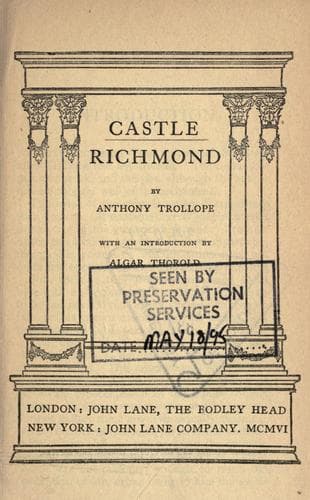
Great Britain -- Fiction; Historical fiction; Ireland -- Fiction; Love stories; Social classes -- Fiction
"You know what I mean. If any doubt as to that is creating this
despondency, it only shows that though we are bound to respect and
relieve my father's state of mind, we are not at all bound to share
it. What would it really matter, mother, if that place in London were
washed away by the Thames? There is more than enough left for us all,
unless--"
"Ah, Herbert, that is it."
"Then I will go to Somers, and he shall tell me. My father's interest
in this property cannot have been involved without his knowledge; and
circumstanced as we and my father are, he is bound to tell me."
"If there be anything within his knowledge to tell, he will tell it."
"And if there be nothing within his knowledge, then I can only look
upon all this as a disease on my poor father's part. I will do all I
can to comfort him in it; but it would be madness to destroy my whole
happiness because he labours under delusions."
Lady Fitzgerald did not know what further to say. She half believed
that Sir Thomas did labour under some delusion; but then she half
believed also that he had upon his mind a sorrow, terribly real,
which was in no sort delusive. Under such circumstances, how could
she advise her son? Instead of advising him, she caressed him.
"But I may claim this from you, mother, that if Somers tells me
nothing which ought to make me break my word to Clara, you will
receive her as your daughter. You will promise me that, will you
not?"
Lady Fitzgerald did promise, warmly; assuring him that she already
dearly loved Clara Desmond, that she would delight in having such
a daughter-in-law, and that she would go to her to welcome her as
such as soon as ever he should bid her do so. With this Herbert was
somewhat comforted, and immediately started on his search after Mr.
Somers.
I do not think that any person is to be found, as a rule, attached
to English estates whose position is analogous to that of an Irish
agent. And there is a wide misunderstanding in England as to these
Irish functionaries. I have attempted, some pages back, to describe
the national delinquencies of a middleman, or profit-renter. In
England we are apt to think that the agents on Irish properties are
to be charged with similar shortcomings. This I can assert to be a
great mistake; and I believe that, as a class, the agents on Irish
properties do their duty in a manner beneficial to the people.
That there are, or were, many agents who were also middlemen, or
profit-renters, and that in this second position they were a nuisance
to the country, is no doubt true. But they were no nuisance in their
working capacity as agents. That there are some bad agents there can
be no doubt, as there are also some bad shoemakers.
Public-domain text, read in full here on John Shaqi.
Reviews
Reviews
No reviews yet
Be the first to share your thoughts on this work.
Elsewhere in the archive
Join the Discussion
Join the discussion
Sign in to leave a comment or review.
Sign InorCreate an account