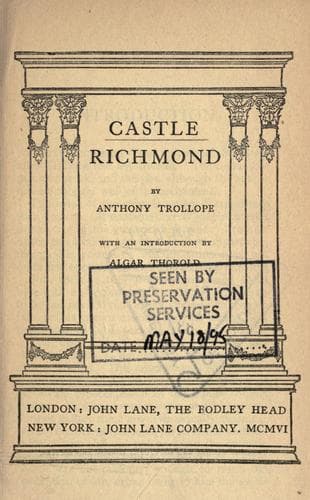
Great Britain -- Fiction; Historical fiction; Ireland -- Fiction; Love stories; Social classes -- Fiction
"Clara, my dear, I think you had better leave the room," said the
countess; "no doubt you have assured Mr. Fitzgerald that you are
engaged to his cousin Herbert."
"Yes, mamma."
"Then he can have no further claim on your attendance, and his
vehemence will terrify you."
"Vehement! how can I help being vehement when, like a ruined gambler,
I am throwing my last chance for such a stake?"
And then he intercepted Clara as she stepped towards the drawing-room
door. She stopped in her course, and stood still, looking down upon
the ground.
"Mr. Fitzgerald," said the countess, "I will thank you to let Lady
Clara leave the room. She has given you the answer for which you have
asked, and it would not be right in me to permit her to be subjected
to further embarrassment."
"I will only ask her to listen to one word. Clara--"
"Mr. Fitzgerald, you have no right to address my daughter with that
freedom," said the countess; but Owen hardly seemed to hear her.
"I here, in your hearing, protest against your marriage with Herbert
Fitzgerald. I claim your love as my own. I bid you think of the
promise which you gave me; and I tell you that as I loved you then
with all my heart, so do I love you at this moment; so shall I love
you always. Now I will not hinder you any longer."
And then he opened the door for her, and she passed on, bowing to
him, and muttering some word of farewell that was inaudible.
He stood for a moment with the door in his hand, meditating whether
he might not say good morning to the countess without returning into
the room; but as he so stood she called him. "Mr. Fitzgerald," she
said; and so he therefore came back, and once more closed the door.
And then he saw that the countenance of Lady Desmond was much
changed. Hitherto she had been every inch the countess, stern and
cold and haughty; but now she looked at him as she used to look in
those old winter evenings when they were accustomed to talk together
over the evening fire in close friendliness, while she, Lady Desmond,
would speak to him in the intimacy of her heart of her children,
Patrick and Clara.
"Mr. Fitzgerald," she said, and the tone of her voice also was
changed. "You are hardly fair to us; are you?"
"Not fair, Lady Desmond?"
"No, not fair. Sit down now, and listen to me for a moment. If you
had a child, a penniless girl like Clara, would you be glad to see
her married to such a one as you are yourself?"
"In what way do you mean? Speak out, Lady Desmond."
"No; I will not speak out, for I would not hurt you. I myself am too
fond of you--as an old friend, to wish to do so. That you may marry
and live happily, live near us here, so that we may know you, I most
heartily desire. But you cannot marry that child."
"And why not, if she loves me?"
Public-domain text, read in full here on John Shaqi.
Reviews
Reviews
No reviews yet
Be the first to share your thoughts on this work.
Elsewhere in the archive
Join the Discussion
Join the discussion
Sign in to leave a comment or review.
Sign InorCreate an account