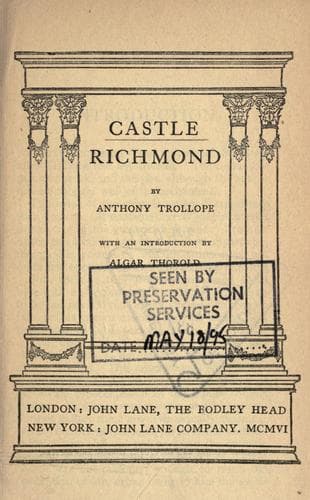
Great Britain -- Fiction; Historical fiction; Ireland -- Fiction; Love stories; Social classes -- Fiction
"Oh, no!" said Herbert.
"Well, there was not much for you to be afraid of, certainly," said
the countess. And so he was appeased, and left the house promising
that he, at any rate, would do nothing that might lead to a quarrel
with his cousin Owen.
Clara, who had still kept on her bonnet, again walked down with him
to the lodge, and encountered his first earnest supplication that an
early day should be named for their marriage. She had many reasons,
excellent good reasons, to allege why this should not be the case.
When was a girl of seventeen without such reasons? And it is so
reasonable that she should have such reasons. That period of having
love made to her must be by far the brightest in her life. Is it not
always a pity that it should be abridged?
"But your father's illness, Herbert, you know."
Herbert acknowledged that, to a certain extent, his father's illness
was a reason--only to a certain extent. It would be worse than
useless to think of waiting till his father's health should be
altogether strong. Just for the present, till Mr. Prendergast should
have gone, and perhaps for a fortnight longer, it might be well to
wait. But after that--and then he pressed very closely the hand which
rested on his arm. And so the matter was discussed between them with
language and arguments which were by no means original.
At the gate, just as Herbert was about to remount his horse, they
were encountered by a sight which for years past had not been
uncommon in the south of Ireland, but which had become frightfully
common during the last two or three months. A woman was standing
there, of whom you could hardly say that she was clothed, though she
was involved in a mass of rags which covered her nakedness. Her head
was all uncovered, and her wild black hair was streaming round her
face. Behind her back hung two children enveloped among the rags in
some mysterious way; and round about her on the road stood three
others, of whom the two younger were almost absolutely naked. The
eldest of the five was not above seven. They all had the same wild
black eyes, and wild elfish straggling locks; but neither the
mother nor the children were comely. She was short and broad in the
shoulders, though wretchedly thin; her bare legs seemed to be of
nearly the same thickness up to the knee, and the naked limbs of the
children were like yellow sticks. It is strange how various are the
kinds of physical development among the Celtic peasantry in Ireland.
In many places they are singularly beautiful, especially as children;
and even after labour and sickness shall have told on them as labour
and sickness will tell, they still retain a certain softness and
grace which is very nearly akin to beauty. But then again in a
neighbouring district they will be found to be squat, uncouth, and in
no way attractive to the eye. The tint of the complexion, the nature
of the hair, the colour of the eyes, shall be the same. But in one
Public-domain text, read in full here on John Shaqi.
Reviews
Reviews
No reviews yet
Be the first to share your thoughts on this work.
Elsewhere in the archive
Join the Discussion
Join the discussion
Sign in to leave a comment or review.
Sign InorCreate an account