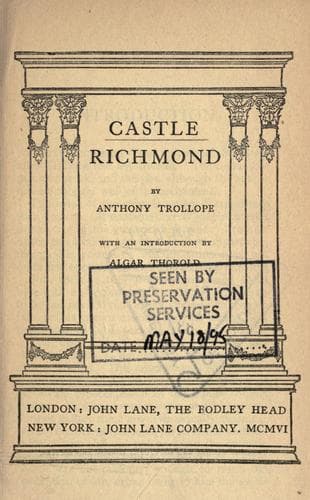
Great Britain -- Fiction; Historical fiction; Ireland -- Fiction; Love stories; Social classes -- Fiction
"Dearest Clara," he said, looking at her with more tenderness than
had ever been usual with him, "I think that you had better leave us.
I could tell it better to your mother alone."
"Do, Clara, love. Go, dearest, and we will call you by-and-by."
Clara moved away very slowly towards the door, and then she turned
round. "If it is anything that makes you unhappy, Herbert," she said,
"I must know it before you leave me."
"Yes, yes; either I or your mother--. You shall be told, certainly."
"Yes, yes, you shall be told," said the countess. "And now go, my
darling." Thus dismissed, Clara did go, and betook herself to her own
chamber. Had Owen had sorrows to tell her, he would have told them to
herself; of that she was quite sure. "And now, Herbert, for heaven's
sake what is it?" said the countess, pale with terror. She was fully
certain now that something was to be spoken which would be calculated
to interfere with her daughter's prospects.
We all know the story which Herbert had to tell, and we need not
therefore again be present at the telling of it. Sitting there, wet
through, in Lady Desmond's drawing-room, he did contrive to utter it
all--the whole of it from the beginning to the end, making it clearly
to be understood that he was no longer Fitzgerald of Castle Richmond,
but a nameless, pennyless outcast, without the hope of portion or
position, doomed from henceforth to earn his bread in the sweat of
his brow--if only he could be fortunate enough to find the means of
earning it.
Nor did Lady Desmond once interrupt him in his story. She sat
perfectly still, listening to him almost with unmoved face. She was
too wise to let him know what the instant working of her mind might
be before she had made her own fixed resolve; and she had conceived
the truth much before he had completed the telling of it. We
generally use three times the number of words which are necessary
for the purpose which we have in hand; but had he used six times the
number, she would not have interrupted him. It was good in him to
give her this time to determine in what tone and with what words
she would speak, when speaking on her part should become absolutely
necessary. "And now," he concluded by saying--and at this time he
was standing up on the rug--"you know it all, Lady Desmond. It will
perhaps be best that Clara should learn it from you."
He had said not a word of giving up his pretensions to Lady Clara's
hand; but then neither had he in any way hinted that the match
should, in his opinion, be regarded as unbroken. He had not spoken of
his sorrow at bringing down all this poverty on his wife; and surely
he would have so spoken had he thought their engagement was still
valid; but then he had not himself pointed out that the engagement
must necessarily be broken, as, in Lady Desmond's opinion, he
certainly should have done.
Public-domain text, read in full here on John Shaqi.
Reviews
Reviews
No reviews yet
Be the first to share your thoughts on this work.
Elsewhere in the archive
Join the Discussion
Join the discussion
Sign in to leave a comment or review.
Sign InorCreate an account