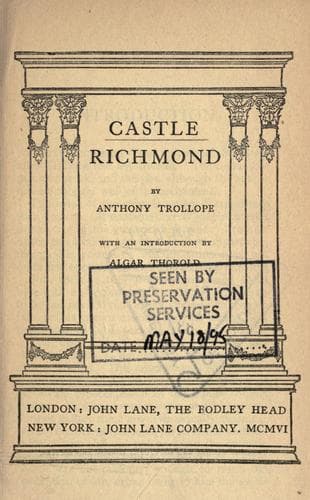
Great Britain -- Fiction; Historical fiction; Ireland -- Fiction; Love stories; Social classes -- Fiction
He had sat down there thinking how he would go to his mother and
offer her solace in her sorrow; how he would bid her be of good
cheer, and encourage her to bear the world as the world had now
fallen to her lot. He had pictured to himself that he would find
her sinking in despair, and had promised himself that with his
vows, his kisses, and his prayers, he would bring her back to her
self-confidence, and induce her to acknowledge that God's mercy was
yet good to her. But now, on awakening, he discovered that she had
been tending him in his misery, and watching him while he slept, that
she might comfort him with her caresses the moment that he awoke to
the remembrance of his misfortunes.
"Herbert, Herbert, my son, my son!" she said again, as she pressed
him close in her arms.
"Mother, has he told you?"
Yes, she had learned it all; but hardly more than she had known
before; or, at any rate, not more than she had expected. As she now
told him, for many days past she had felt that this trouble which had
fallen upon his father must have come from the circumstances of their
marriage. And she would have spoken out, she said, when the idea
became clear to her, had she not then been told that Mr. Prendergast
had been invited to come thither from London. Then she knew that she
had better remain silent, at any rate till his visit had been made.
And Herbert again sat in the chair, and his mother crouched, or
almost kneeled, on the cushion at his knee. "Dearest, dearest,
dearest mother," he said, as he supported her head against his
shoulder, "we must love each other now more than ever we have loved."
"And you forgive us, Herbert, for all that we have done to you?"
"Mother, if you speak in that way to me you will kill me. My darling,
darling mother!"
There was but little more said between them upon the matter--but
little more, at least, in words; but there was an infinity of
caresses, and deep--deep assurances of undying love and confidence.
And then she asked him about his bride, and he told her where he
had been, and what had happened. "You must not claim her, Herbert,"
she said to him. "God is good, and will teach you to bear even that
also."
"Must I not?" he asked, with a sadly plaintive voice.
"No, my child. You invited her to share your prosperity, and would it
be just--"
"But, mother, if she wills it?"
"It is for you to give her back her troth, then leave it to time and
her own heart."
"But if she love me, mother, she will not take back her troth. Would
I take back hers because she was in sorrow?"
"Men and women, Herbert, are different. The oak cares not whether the
creeper which hangs to it be weak or strong. If it be weak the oak
can give it strength. But the staff which has to support the creeper
must needs have strength of its own."
Public-domain text, read in full here on John Shaqi.
Reviews
Reviews
No reviews yet
Be the first to share your thoughts on this work.
Elsewhere in the archive
Join the Discussion
Join the discussion
Sign in to leave a comment or review.
Sign InorCreate an account