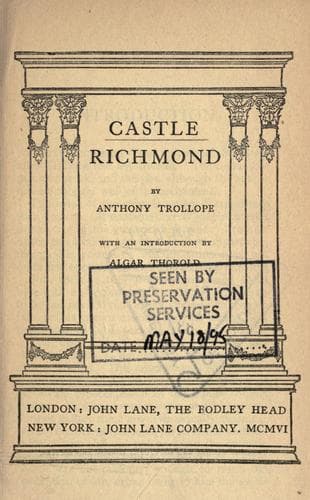
Great Britain -- Fiction; Historical fiction; Ireland -- Fiction; Love stories; Social classes -- Fiction
And then, when Herbert left the room, Emmeline followed him. She had
ever been his dearest sister, and now she longed to be with him that
she might tell him how she loved him, and comfort him with her tears.
And Clara too--Clara whom she had welcomed as a sister!--she must
learn now how Clara would behave, for she had already made herself
sure that her brother had been at Desmond Court, the herald of his
own ruin.
"May I come with you, Herbert?" she asked, closing in round him and
getting under his arm. How could he refuse her? So they went together
and sat over a fire in a small room that was sacred to her and her
sister, and there, with many sobs on her part and much would-be brave
contempt of poverty on his, they talked over the altered world as it
now showed itself before them.
"And you did not see her?" she asked, when with many efforts she had
brought the subject round to Clara Desmond and her brother's walk to
Desmond Court.
"No; she left the room at my own bidding. I could not have told it
myself to her."
"And you cannot know then what she would say?"
"No, I cannot know what she would say; but I know now what I must
say myself. All that is over, Emmeline. I cannot ask her to marry a
beggar."
"Ask her; no! there will be no need of asking her; she has already
given you her promise. You do not think that she will desert you? you
do not wish it?"
Herein were contained two distinct questions, the latter of which
Herbert did not care to answer. "I shall not call it desertion," he
said; "indeed the proposal will come from me. I shall write to her,
telling her that she need think about me no longer. Only that I am so
weary I would do it now."
"And how will she answer you? If she is the Clara that I take her
for she will throw your proposal back into your face. She will tell
you that it is not in your power to reject her now. She will swear
to you, that let your words be what they may, she will think of
you--more now than she has ever thought in better days. She will tell
you of her love in words that she could not use before. I know she
will. I know that she is good, and true, and honest, and generous.
Oh, I should die if I thought she were false! But, Herbert, I am sure
that she is true. You can write your letter, and we shall see."
Herbert, with wise arguments learned from his mother, reasoned with
his sister, explaining to her that Clara was now by no means bound to
cling to him; but as he spoke them his arm fastened itself closely
round his sister's waist, for the words which she uttered with so
much energy were comfortable to him.
Public-domain text, read in full here on John Shaqi.
Reviews
Reviews
No reviews yet
Be the first to share your thoughts on this work.
Elsewhere in the archive
Join the Discussion
Join the discussion
Sign in to leave a comment or review.
Sign InorCreate an account