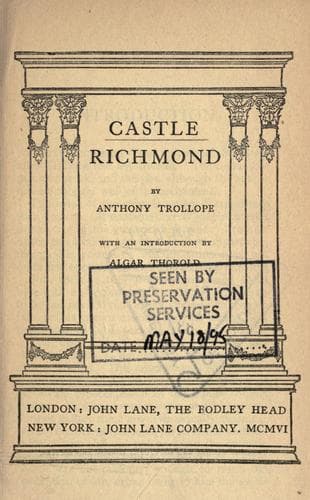
Great Britain -- Fiction; Historical fiction; Ireland -- Fiction; Love stories; Social classes -- Fiction
And then Aunt Letty found that there was no necessity for her to
continue her speech, and indeed no possibility of her doing so even
if she were so minded. The children began to wail and cry, and
the mothers also mixed loud sobbings with their loud prayers; and
Emmeline and Mary, dissolved in tears, sat themselves down, drawing
to them the youngest bairns and those whom they had loved the best,
kissing their sallow, famine-stricken, unwholesome faces, and weeping
over them with a love of which hitherto they had been hardly
conscious.
There was not much more in the way of speech possible to any of
them, for even Aunt Letty was far gone in tender wailing; and it
was wonderful to see the liberties that were taken even with that
venerable bonnet. The women had first of all taken hold of her hands
to kiss them, and had kissed her feet, and her garments, and her
shoulders, and then behind her back they had made crosses on her,
although they knew how dreadfully she would have raged had she caught
them polluting her by such doings; and they grasped her arms and
embraced them, till at last, those who were more daring, reached her
forehead and her face, and poor old Aunt Letty, who in her emotion
could not now utter a syllable, was almost pulled to pieces among
them.
Mary and Emmeline had altogether surrendered themselves, and were
the centres of clusters of children who hung upon them. And the sobs
now were no longer low and tearful, but they had grown into long,
protracted groanings, and loud wailings, and clapping of hands, and
tearings of the hair. O, my reader, have you ever seen a railway
train taking its departure from an Irish station, with a freight
of Irish emigrants? if so, you know how the hair is torn, and how
the hands are clapped, and how the low moanings gradually swell
into notes of loud lamentation. It means nothing, I have heard men
say,--men and women too. But such men and women are wrong. It means
much; it means this: that those who are separated, not only love each
other, but are anxious to tell each other that they so love. We have
all heard of demonstrative people. A demonstrative person, I take
it, is he who is desirous of speaking out what is in his heart. For
myself I am inclined to think that such speaking out has its good
ends. "The faculty of silence! is it not of all things the most
beautiful?" That is the doctrine preached by a great latter-day
philosopher; for myself, I think that the faculty of speech is
much more beautiful--of speech if it be made but by howlings, and
wailings, and loud clappings of the hand. What is in a man, let it
come out and be known to those around him; if it be bad it will find
correction; if it be good it will spread and be beneficent.
Public-domain text, read in full here on John Shaqi.
Reviews
Reviews
No reviews yet
Be the first to share your thoughts on this work.
Elsewhere in the archive
Join the Discussion
Join the discussion
Sign in to leave a comment or review.
Sign InorCreate an account