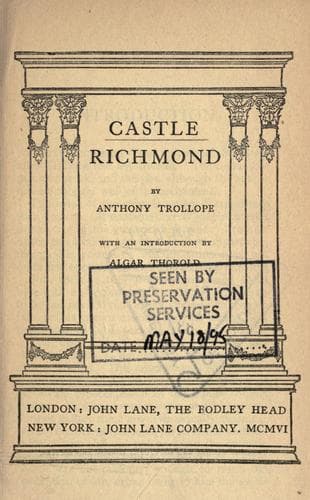
Great Britain -- Fiction; Historical fiction; Ireland -- Fiction; Love stories; Social classes -- Fiction
"Was she your own?" asked Herbert, speaking hardly above his breath.
"'Deed, yes!" said the woman. "She was my own, own little Kitty." But
there was no tear in her eye or gurgling sob audible from her throat.
"And when did she die?" he asked.
"'Deed, thin, and I don't jist know--not exactly;" and sinking lower
down upon her haunches, she put up to her forehead the hand with
which she had supported herself on the floor--the hand which was not
occupied with the baby, and pushing back with it the loose hairs from
her face, tried to make an effort at thinking.
"She was alive in the night, wasn't she?" he said.
"I b'lieve thin she was, yer honour. 'Twas broad day, I'm thinking,
when she guv' over moaning. She warn't that way when he went away."
"And who's he?"
"Jist Mike, thin."
"And is Mike your husband?" he asked. She was not very willing to
talk; but it appeared at last that Mike was her husband, and that
having become a cripple through rheumatism, he had not been able to
work on the roads. In this condition he and his should of course have
gone into a poor-house. It was easy enough to give such advice in
such cases when one came across them, and such advice when given
at that time was usually followed; but there were so many who had
no advice, who could get no aid, who knew not which way to turn
themselves! This wretched man had succeeded in finding some one who
would give him his food--food enough to keep himself alive--for such
work as he could do in spite of his rheumatism, and this work to
the last he would not abandon. Even this was better to him than
the poor-house. But then, as long as a man found work out of the
poor-house, his wife and children would not be admitted into it. They
would not be admitted if the fact of the working husband was known.
The rule in itself was salutary, as without it a man could work,
earning such wages as were adjudged to be needful for a family, and
at the same time send his wife and children to be supported on the
rates. But in some cases, such as this, it pressed very cruelly.
Exceptions were of course made in such cases, if they were known: but
then it was so hard to know them!
Public-domain text, read in full here on John Shaqi.
Reviews
Reviews
No reviews yet
Be the first to share your thoughts on this work.
Elsewhere in the archive
Join the Discussion
Join the discussion
Sign in to leave a comment or review.
Sign InorCreate an account