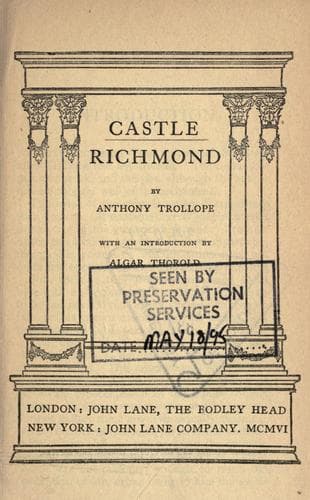
Great Britain -- Fiction; Historical fiction; Ireland -- Fiction; Love stories; Social classes -- Fiction
He had spent the long evening before his last dinner in going round
the whole demesne alone, so that no eye should witness what he felt.
None but those who have known the charms of a country-house early in
life can conceive the intimacy to which a man attains with all the
various trifling objects round his own locality; how he knows the
bark of every tree, and the bend of every bough; how he has marked
where the rich grass grows in tufts, and where the poorer soil is
always dry and bare; how he watches the nests of the rooks, and the
holes of the rabbits, and has learned where the thrushes build, and
can show the branch on which the linnet sits. All these things had
been dear to Herbert, and they all required at his hand some last
farewell. Every dog, too, he had to see, and to lay his hand on
the neck of every horse. This making of his final adieu under such
circumstances was melancholy enough.
And then, too, later in the evening, after dinner, all the servants
were called into the parlour that he might shake hands with them.
There was not one of them who had not hoped, as lately as three
months since, that he or she would live to call Herbert Fitzgerald
master. Indeed, he had already been their master--their young master.
All Irish servants especially love to pay respect to the "young
masther;" but Herbert now was to be their master no longer, and the
probability was that he would never see one of them again.
He schooled himself to go through the ordeal with a manly gait and
with dry eyes, and he did it; but their eyes were not dry, not even
those of the men. Mrs. Jones and a favourite girl whom the young
ladies patronized were not of the number, for it had been decided
that they should follow the fortunes of their mistress; but Richard
was there, standing a little apart from the others, as being now on a
different footing. He was to go also, but before the scene was over
he also had taken to sobbing violently.
"I wish you all well and happy," said Herbert, making his little
speech, "and regret deeply that the intercourse between us should be
thus suddenly severed. You have served me and mine well and truly,
and it is hard upon you now, that you should be bid to go and seek
another home elsewhere."
"It isn't that we mind, Mr. Herbert; it ain't that as frets us," said
one of the men.
"It ain't that at all, at all," said Richard, doing chorus; "but that
yer honour should be robbed of what is yer honour's own."
"But you all know that we cannot help it," continued Herbert; "a
misfortune has come upon us which nobody could have foreseen, and
therefore we are obliged to part with our old friends and servants."
At the word friends the maid-servants all sobbed. "And 'deed we is
your frinds, and true frinds, too," wailed the cook.
Public-domain text, read in full here on John Shaqi.
Reviews
Reviews
No reviews yet
Be the first to share your thoughts on this work.
Elsewhere in the archive
Join the Discussion
Join the discussion
Sign in to leave a comment or review.
Sign InorCreate an account