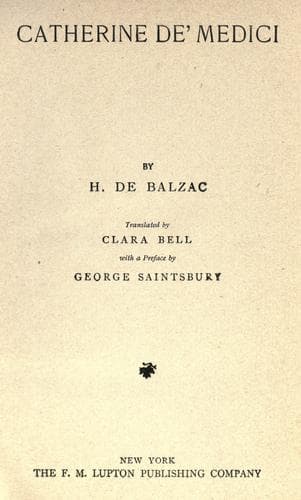
Catherine de Médicis, Queen, consort of Henry II, King of France, 1519-1589 -- Fiction; French fiction -- Translations into English
morrow,--having, moreover, lived the exact number of years given to her
by all her horoscopes.
These predictions, which were known to the Cardinal de Lorraine,
who regarded them as witchcraft, were now in process of realization.
Francois II. had reigned his two revolutions of the wheel, and Charles
IX. was now making his last turn. If Catherine said the strange words
which history has attributed to her when her son Henri started for
Poland,--“You will soon return,”--they must be set down to her faith in
occult science and not to the intention of poisoning Charles IX.
Many other circumstances corroborated Catherine’s faith in the occult
sciences. The night before the tournament at which Henri II. was killed,
Catherine saw the fatal blow in a dream. Her astrological council, then
composed of Nostradamus and the two Ruggieri, had already predicted
to her the death of the king. History has recorded the efforts made
by Catherine to persuade her husband not to enter the lists. The
prognostic, and the dream produced by the prognostic, were verified. The
memoirs of the day relate another fact that was no less singular. The
courier who announced the victory of Moncontour arrived in the
night, after riding with such speed that he killed three horses. The
queen-mother was awakened to receive the news, to which she replied,
“I knew it already.” In fact, as Brantome relates, she had told of her
son’s triumph the evening before, and narrated several circumstances of
the battle. The astrologer of the house of Bourbon predicted that the
youngest of all the princes descended from Saint-Louis (the son of
Antoine de Bourbon) would ascend the throne of France. This prediction,
related by Sully, was accomplished in the precise terms of the
horoscope; which led Henri IV. to say that by dint of lying these people
sometimes hit the truth. However that may be, if most of the great
minds of that epoch believed in this vast science,--called Magic by the
masters of judicial astrology, and Sorcery by the public,--they were
justified in doing so by the fulfilment of horoscopes.
It was for the use of Cosmo Ruggiero, her mathematician, astronomer, and
astrologer, that Catherine de’ Medici erected the tower behind the Halle
aux Bles,--all that now remains of the hotel de Soissons. Cosmo Ruggiero
possessed, like confessors, a mysterious influence, the possession of
which, like them again, sufficed him. He cherished an ambitious
thought superior to all vulgar ambitions. This man, whom dramatists and
romance-writers depict as a juggler, owned the rich abbey of Saint-Mahe
in Lower Brittany, and refused many high ecclesiastical dignities; the
gold which the superstitious passions of the age poured into his coffers
sufficed for his secret enterprise; and the queen’s hand, stretched
above his head, preserved every hair of it from danger.
II. SCHEMES AGAINST SCHEMES
Public-domain text, read in full here on John Shaqi.
Reviews
Reviews
No reviews yet
Be the first to share your thoughts on this work.
Elsewhere in the archive
Join the Discussion
Join the discussion
Sign in to leave a comment or review.
Sign InorCreate an account