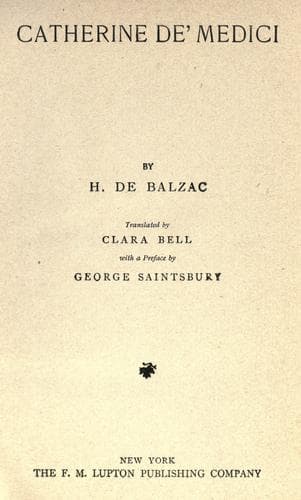
Catherine de Médicis, Queen, consort of Henry II, King of France, 1519-1589 -- Fiction; French fiction -- Translations into English
Looking out for a chance of mischief,--a belated burgher to frighten,
or a watchman to thrash--the king went along with his nose in the air,
watching all the lighted windows to see what was happening, and striving
to hear the conversations. But alas! he found his good city of Paris in
a state of deplorable tranquillity. Suddenly, as he passed the house
of a perfumer named Rene, who supplied the court, the king, noticing
a strong light from a window in the roof, was seized by one of those
apparently hasty inspirations which, to some minds, suggest a previous
intention.
This perfumer was strongly suspected of curing rich uncles who thought
themselves ill. The court laid at his door the famous “Elixir of
Inheritance,” and even accused him of poisoning Jeanne d’Albret, mother
of Henri of Navarre, who was buried (in spite of Charles IX.’s positive
order) without her head being opened. For the last two months the king
had sought some way of sending a spy into Rene’s laboratory, where, as
he was well aware, Cosmo Ruggiero spent much time. The king intended,
if anything suspicious were discovered, to proceed in the matter alone,
without the assistance of the police or law, with whom, as he well knew,
his mother would counteract him by means of either corruption or fear.
It is certain that during the sixteenth century, and the years that
preceded and followed it, poisoning was brought to a perfection unknown
to modern chemistry, as history itself will prove. Italy, the cradle of
modern science, was, at this period, the inventor and mistress of these
secrets, many of which are now lost. Hence the reputation for that crime
which weighed for the two following centuries on Italy. Romance-writers
have so greatly abused it that wherever they have introduced Italians
into their tales they have almost always made them play the part of
assassins and poisoners.[*] If Italy then had the traffic in subtle
poisons which some historians attribute to her, we should remember her
supremacy in the art of toxicology, as we do her pre-eminence in all
other human knowledge and art in which she took the lead in Europe.
The crimes of that period were not her crimes specially. She served the
passions of the age, just as she built magnificent edifices, commanded
armies, painted noble frescos, sang romances, loved queens, delighted
kings, devised ballets and fetes, and ruled all policies. The horrible
art of poisoning reached to such a pitch in Florence that a woman,
dividing a peach with a duke, using a golden fruit-knife with one side
of its blade poisoned, ate one half of the peach herself and killed the
duke with the other half. A pair of perfumed gloves were known to have
infiltrated mortal illness through the pores of the skin. Poison
was instilled into bunches of natural roses, and the fragrance, when
inhaled, gave death. Don John of Austria was poisoned, it was said, by a
pair of boots.
[*] Written sixty-six years ago.--Tr.
Public-domain text, read in full here on John Shaqi.
Reviews
Reviews
No reviews yet
Be the first to share your thoughts on this work.
Elsewhere in the archive
Join the Discussion
Join the discussion
Sign in to leave a comment or review.
Sign InorCreate an account