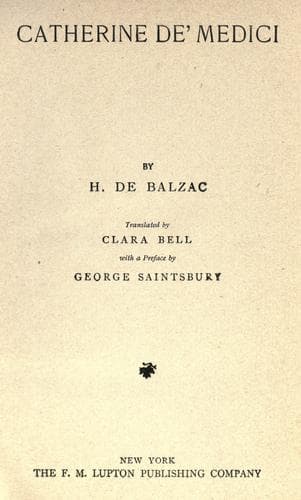
Catherine de Médicis, Queen, consort of Henry II, King of France, 1519-1589 -- Fiction; French fiction -- Translations into English
This answer made all who were within hearing of it smile. The seduction
of Francoise de Rohan by the Duc de Nemours was the topic of all
conversations; but, as the duke was cousin to Francois II., and doubly
allied to the house of Valois through his mother, the Guises regarded
him more as the seduced than the seducer. Nevertheless, the power of the
house of Rohan was such that the Duc de Nemours was obliged, after the
death of Francois II., to leave France on consequence of suits brought
against him by the Rohans; which suits the Guises settled. The duke’s
marriage with the Duchesse de Guise after Poltrot’s assassination of
her husband in 1563, may explain the question which she put to Amyot,
by revealing the rivalry which must have existed between Mademoiselle de
Rohan and the duchess.
“Do see that group of the discontented over there?” said the Comte de
Grammont, motioning toward the Messieurs de Coligny, the Cardinal de
Chatillon, Danville, Thore, Moret, and several other seigneurs suspected
of tampering with the Reformation, who were standing between two windows
on the other side of the fireplace.
“The Huguenots are bestirring themselves,” said Cypierre. “We know that
Theodore de Beze has gone to Nerac to induce the Queen of Navarre to
declare for the Reformers--by abjuring publicly,” he added, looking at
the _bailli_ of Orleans, who held the office of chancellor to the Queen
of Navarre, and was watching the court attentively.
“She will do it!” said the _bailli_, dryly.
This personage, the Orleans Jacques Coeur, one of the richest burghers
of the day, was named Groslot, and had charge of Jeanne d’Albret’s
business with the court of France.
“Do you really think so?” said the chancellor of France, appreciating
the full importance of Groslot’s declaration.
“Are you not aware,” said the burgher, “that the Queen of Navarre has
nothing of the woman in her except sex? She is wholly for things virile;
her powerful mind turns to the great affairs of State; her heart is
invincible under adversity.”
“Monsieur le cardinal,” whispered the Chancellor Olivier to Monsieur
de Tournon, who had overheard Groslot, “what do you think of that
audacity?”
“The Queen of Navarre did well in choosing for her chancellor a man from
whom the house of Lorraine borrows money, and who offers his house to
the king, if his Majesty visits Orleans,” replied the cardinal.
The chancellor and the cardinal looked at each other, without venturing
to further communicate their thoughts; but Robertet expressed them, for
he thought it necessary to show more devotion to the Guises than these
great personages, inasmuch as he was smaller than they.
“It is a great misfortune that the house of Navarre, instead of abjuring
the religion of its fathers, does not abjure the spirit of vengeance
and rebellion which the Connetable de Bourbon breathed into it,” he said
aloud. “We shall see the quarrels of the Armagnacs and the Bourguignons
revive in our day.”
Public-domain text, read in full here on John Shaqi.
Reviews
Reviews
No reviews yet
Be the first to share your thoughts on this work.
Elsewhere in the archive
Join the Discussion
Join the discussion
Sign in to leave a comment or review.
Sign InorCreate an account