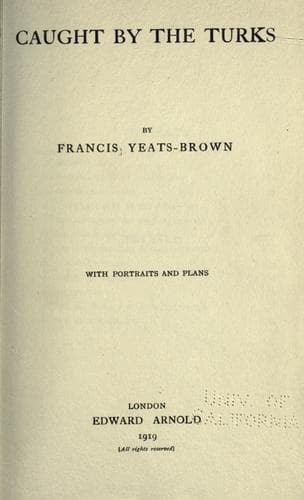
World War, 1914-1918 -- Prisoners and prisons, Turkish
How the war, as seen at close quarters, struck a man eminent in another
profession than that of arms is the distinguishing feature of this
volume of personal impressions. It is not, however, merely the outcome
of a few weeks' sojourn or "trip to the trenches," with one eye on an
expectant public, for the author has four times seen autumn fade into
winter on the flat countryside of Flanders, and, when the war ended, was
still at his post rendering invaluable services amidst unforgettable
scenes. The author's comments on the day-to-day happenings are
distinguished by a tone that is at once manly, reflective, and
good-humoured. Medical questions are naturally prominent, but are dealt
with largely in a manner that should interest the layman at the present
time. Sir Wilmot was with Lord Roberts when he died. A very pleasing
feature of the book is the constant revelation of the author's love of
nature and sport, and his happy way of introducing such topics, together
with descriptions of the country around him, makes a welcome contrast to
the stern events which form the staple material of the book. There are
some very amusing stories.
LONDON MEN IN PALESTINE.
By ROWLANDS COLDICOTT.
_With maps. 1 vol. Demy 8vo._ =12s. 6d. net.=
This book embraces so much more than the ordinary war story that we have
a peculiar difficulty in describing it in a few chosen words.
The curtain lifts the day after the battle of Sheria, one of the minor
fights in General Allenby's first campaign--those movements of troops
which came only to a pause with the capture of Jerusalem. Gaza has just
been taken. You are introduced to one of the companies of a London
battalion serving in the East, of which company the author is commander.
The reading of a few lines, the passing of a few moments, causes you
(such is the power of right words) to be _attached_ to that company and
to move in imagination with it across the dazzling plain. When you have
tramped a few miles you begin to realise, perhaps for the first time,
the heat and torment of a day's march in Philistia. It is not long
before you feel that you, too, are adventuring with the toiling
soldiers; with them you wonder where the halting place will be, what
sort of bivouac you are likely to hit upon. By this time you will have
met the officers--Temple, Trobus, Jackson--and are coming to have a
nodding acquaintance with the men. Desire to compass the unknown, and
sympathetic interest in the experiences of a company of your own
country-men, Londoners footing it in a foreign land, now takes you
irresistibly into the very heart of the tale, and you become one with
the narrator. With him you wander among the ruins of Gaza, pass into
southern Palestine, and come to the foot-hills of Judea. With him you
slowly become conscious that the long series of marches is planned to
culminate in an assault upon Jerusalem. Now you are part of a dusty
column winding up into Judea by the Jerusalem road, looking hour by hour
Public-domain text, read in full here on John Shaqi.
Reviews
Reviews
No reviews yet
Be the first to share your thoughts on this work.
Elsewhere in the archive
Join the Discussion
Join the discussion
Sign in to leave a comment or review.
Sign InorCreate an account