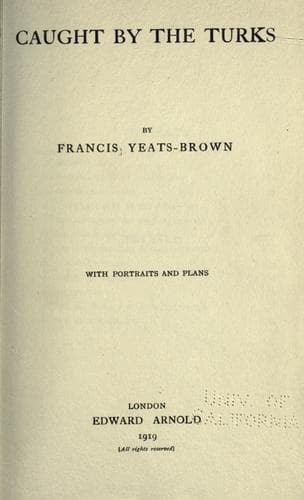
World War, 1914-1918 -- Prisoners and prisons, Turkish
A series of charming sketches by a young New Zealander, who died in
December, 1917, on the threshold of a brilliant literary career. Noel
Ross was one of those daring Anzacs who made the landing on Gallipoli.
Wounded in the early days of the terrible fighting there, he was
discharged from the Army, came to London, rejoined there, and obtained a
commission in the Royal Field Artillery. Afterwards he became a valued
member of the Editorial Staff of _The Times_, on which his genius was at
once recognized and highly appreciated. Much of his work appeared in
_The Times_, and he was also a contributor to _Punch_. In collaboration
with his father, Captain Malcolm Ross, the New Zealand War
Correspondent, he was the author of "Light and Shade in War," of which
the _Daily Mail_ said: "It is full of Anzac virility, full of Anzac
buoyancy, and surcharged with that devil-may-care humour that has so
astounded us jaded peoples of an older world."
His writings attracted the attention of such capable writers as Rudyard
Kipling, and Sir Ian Hamilton, who said he reminded him in many ways of
that gallant and brilliant young Englishman, Rupert Brooke.
WITH THE BRITISH INTERNED IN SWITZERLAND.
By Lieut.-Colonel H. P. PICOT, C.B.E.,
Late Military Attache, 1914-16, and British Officer in Charge of the
Interned, 1916-18.
_1 vol. Demy 8vo. Cloth._ =10s. 6d. net.=
In this volume Colonel Picot tells us, in simple and lucid fashion, how
some thousands of our much tried and suffering countrymen were
transferred--to the eternal credit of Switzerland--from the harsh
conditions of captivity to a neutral soil, there to live in comparative
freedom amid friendly surroundings. He describes in some detail the
initiative taken by the Swiss Government on behalf of the Prisoners of
War in general, and the negociations which preceded the acceptance by
the Belligerent States of the principle of Internment, and then recounts
the measures taken by that Government for the hospitalization of some
30,000 Prisoners of War, and the organization of a Medical Service for
the treatment of the sick and wounded.
Turning, then, more particularly to the group of British prisoners, he
deals with their discipline, their camp life, the steps taken for
spiritual welfare, and the organization of sports and recreations, and
an interesting chapter records the efforts made to afford them technical
training in view of their return to civil life.
The book also comprises a resume of the formation and development of the
Bread Bureau at Berne, which ultimately, in providing bread for 100,000
British prisoners of war in Germany, doubtless saved countless lives;
and a description of the activities of the British Legation Red Cross
Organization, both of which institutions were founded by Lady Grant
Duff, wife of H.M.'s Minister at Berne.
Public-domain text, read in full here on John Shaqi.
Reviews
Reviews
No reviews yet
Be the first to share your thoughts on this work.
Elsewhere in the archive
Join the Discussion
Join the discussion
Sign in to leave a comment or review.
Sign InorCreate an account