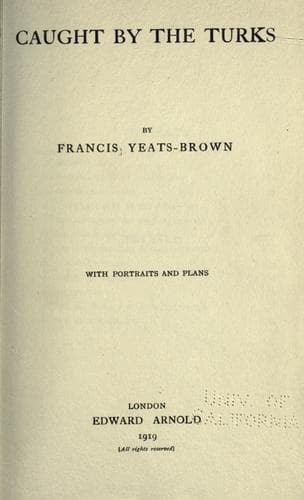
World War, 1914-1918 -- Prisoners and prisons, Turkish
It took two seconds to slip down thirty feet of rope, and two seconds is
a long time when your liberty, if not your life, is at stake. I half
kicked down the sign-board of a shop in my descent, and Robin, who
followed, completed the disaster. In our haste, we had cut our hands
almost to the bone, and had made noise enough to wake the dead.
Yet no one stirred. We were both in the street, and no one had moved.
After two and a half years of captivity we were free men once more. The
slothful years had vanished in the twinkling of an eye. Can you realise
the miracle, liberty-loving reader, that passes in the mind of a man who
thus suddenly realises his freedom? . . .
I don't know what Robin thought, for we said nothing. We lit cigarettes
and strolled away. But inside of me, the motors of the nervous system
raced.
The only other danger, in our hour and a half's walk to our destination,
was being asked for passports by some policeman. In our character as
polyglot mechanics, whenever we passed anyone, I found it a great
relief to make some such remark as:
Lieb Vaterland, magst ruhig sein,
Fest steht and treu die Wacht am Rhein.
But Robin, who could not understand my German, paid little heed.
Only once we did think we were likely to be recaught. At about one in
the morning, as we were passing the Fatih mosque, we heard a rattle on
the cobbles behind us. A carriage was being galloped in our direction.
It might well contain some of the Psamattia garrison. We doubled into
some ruins, and lay there, while the clatter grew louder and louder.
A few wisps of cloud crossed the moon, that had reached her zenith.
Their silent shadows moved like ghosts across the desolation of the
city. A cat was abroad. She saw us, and halted, with paw uplifted and
blazing eyes.
Then the carriage passed, empty, with a drunken driver. It rattled away
into the night, and we emerged, and took our way through the streets of
old Stamboul, under the chequered shade of vines.
[Footnote 6: This applies in no way to the Americans, who did everything
possible for our men before they left Constantinople. Their assistance
was always of the most prompt and practical nature. It may be invidious
to mention names in this light account of adventure, but I cannot
refrain from giving myself the pleasure of saying how grateful I am to
Mr. Hoffman Phillips, of the American Embassy. His name, as also the
name of his chief, Mr. Morgenthau, is indissolubly connected with our
early prisoners. I wish to thank him from the bottom of my heart, and I
know many of all ranks who will join with me in this--far too
meagre--tribute to his activities and ability.]
Public-domain text, read in full here on John Shaqi.
Reviews
Reviews
No reviews yet
Be the first to share your thoughts on this work.
Elsewhere in the archive
Join the Discussion
Join the discussion
Sign in to leave a comment or review.
Sign InorCreate an account