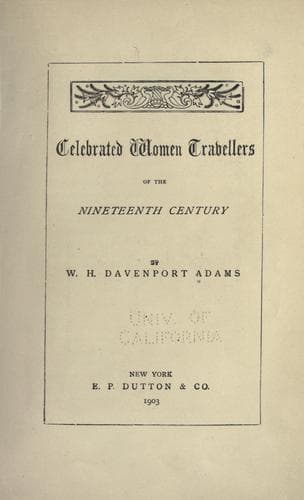
Celebrated Women Travellers of the Nineteenth CenturyAdams, W. H. Davenport (William Henry Davenport)
History
Celebrated Women Travellers of the Nineteenth Century
Adams, W. H. Davenport (William Henry Davenport)
Women travelers -- Biography
With indefatigable energy of mind and body, Madame Pfeiffer visited
Colombo and Kandy, the chief towns of the island. At the latter she
obtained admission to the temple of Dagoba, which contains a precious
relic of Buddha, namely, one of his teeth. The sanctuary enshrining it
is a small chamber or cell, less than twenty feet in breadth. It is
shrouded in darkness, for of windows there are none, and the door is
curtained inside, still more effectually to exclude the light. Rich
tapestry covers the walls and ceiling. But the principal object is the
altar, which glitters with plates of silver, and is encrusted about the
edges with precious stones. Upon it rests a bell-shaped case, about
three feet high, and at the base three feet in diameter. It is made of
silver, is elaborately gilt, and decorated with costly jewels. In the
middle blazes a peacock of precious stones. Six smaller cases, said to
be of gold, each diminishing in size, are enclosed within the large
case, and under the last is the tooth of Buddha. It is as large as that
of a great bull, so the great Indian philosopher must have had a
monstrous jaw!
Madame Pfeiffer arrived at Madras on the 30th of October. Thence she
proceeded to Calcutta, the city of palaces; but, of course, she adds
nothing to the information furnished by a swarm of travellers. She saw
the broad flood of the Ganges, and, filling a glass with its sacred
water, drank to the health of the Europeans and all whom she loved.
Throughout her Indian travel she felt much vexed at being conveyed in a
palanquin; it seemed a dishonouring of men to treat them as beasts of
burden. However, necessity prevailed over her humanitarian scruples.
Unlike the majority of Indian tourists, she went everywhere without an
expensive retinue of attendants; she had but one servant, yet she
contrived to go everywhere, and to see all that was to be seen. It is
worth noting that she reduced the cost of travel to a minimum, and
accomplished the circuit of the globe for a less sum than the rent of a
furnished house in Mayfair for only a twelvemonth. It is true that she
submitted to privations which the English tourist would deem
insupportable; she embarked in sailing ships because they were cheaper
than steamers; resorted to third-class railway carriages; avoided
expensive hotels; lived always with the "masses" and on plainest fare;
and dispensed with the services of dragoman or interpreter. But for all
that her enjoyment was not the less, and she saw much which, had she
travelled in the usual fashion, she would not have seen.
Public-domain text, read in full here on John Shaqi.
Reviews
Reviews
No reviews yet
Be the first to share your thoughts on this work.
Elsewhere in the archive
Join the Discussion
Join the discussion
Sign in to leave a comment or review.
Sign InorCreate an account