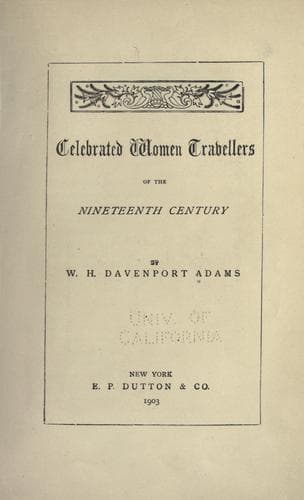
Celebrated Women Travellers of the Nineteenth CenturyAdams, W. H. Davenport (William Henry Davenport)
History
Celebrated Women Travellers of the Nineteenth Century
Adams, W. H. Davenport (William Henry Davenport)
Women travelers -- Biography
There is another light in which this vast desert may be looked at.
Unquestionably, its influence on the destinies of the human race has
been injurious; it has checked the progress of the Semitic civilization.
The primitive peoples of India and Tibet were civilized at an early
period of the world's history; but the immense wilderness put an
impassable barrier between them and the barbarous tribes of Northern
Asia. More than the Himalaya, more than the snow-capped peaks of
Sirinagur and Gorkha, these boundless wastes, alternately withered by a
tropical summer, and blighted by a rigorous winter, have prevented for
ages all intercommunication, all fusion between the inhabitants of
Northern and those of Southern Asia; and it is thus that India and
Tibet have remained the only regions of this part of the world which
have enjoyed the benefits of civilization, of the refinement of manners,
and of the genius of the arts.
The barbarians who, in the last agonies of the Roman Empire, invaded and
devastated Europe, issued from the steppes and table-lands of Mongolia.
As Humboldt says--"If intellectual culture has directed its course from
the East to the West, like the vivifying light of the sun, barbarism at
a later period followed the same route, when it threatened to plunge
Europe again into darkness. A tawny race of shepherds of Thon-Klueu--that
is to say, of Turkish origin, the Hioungum--inhabited, living under
sheepskin tents, the elevated table-land of Gobi. Long formidable to the
Chinese power, a portion of the Hioungum were driven south into Central
Asia. The impulse thus given, uninterruptedly propagated itself to the
primitive country of the Fins, on the banks of the Ural, whence irrupted
a torrent of Huns, Avars, Chasars, and divers mixtures of Asiatic races.
The armies of the Huns first appeared on the banks of the Volga, then in
Pannonia, finally on the borders of the Marne and the Po, ravaging the
beautiful plains where, from the time of Antwor, the genius of man had
accumulated monuments upon monuments. Thus blew from the Mongolian
desert a pestilential wind which, even as far as the Cisalpine plains,
blighted the delicate flower of art, the object of cares so constant and
so tender."[18]
The temperature is extremely variable in these steppes, so that Madame
de Bourboulon records having experienced in the morning a frost of one
degree below zero, and some hours afterwards a heat of thirty degrees
above zero (Centigrade). These changes are most numerous and most
violent in the spring.
Public-domain text, read in full here on John Shaqi.
Reviews
Reviews
No reviews yet
Be the first to share your thoughts on this work.
Elsewhere in the archive
Join the Discussion
Join the discussion
Sign in to leave a comment or review.
Sign InorCreate an account