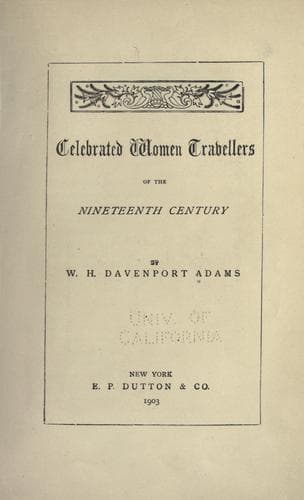
Celebrated Women Travellers of the Nineteenth CenturyAdams, W. H. Davenport (William Henry Davenport)
History
Celebrated Women Travellers of the Nineteenth Century
Adams, W. H. Davenport (William Henry Davenport)
Women travelers -- Biography
There is a very charming book, brightly written, and dealing with an
interesting people, which reaches very high in the literature of travel.
We refer to Lady Eastlake's "Residence on the Shores of the Baltic,
described in a series of Letters," in which, with a polished pen and a
quick observation, she sets before us the patriarchal simplicity of life
and honest character of the Esthonians. Travel-books by ladies were rare
at the time that Lady Eastlake (then Miss Rigby) wrote, and the success
of her work was influenced, no doubt, by this rarity; but its reputation
may well rest upon its genuine merit. Only, justice compels us to say
that writing of almost equal merit, sometimes of superior, is now poured
out every year, nay, every month, by adventurers of the "other sex." A
female traveller has ceased to be a _rara avis_; delicately-nurtured
women now climb Mont Blanc or penetrate into the Norwegian forests, or
cross the Pacific, or traverse sandy deserts, or visit remote isles, in
company with their husbands and brothers, or "unprotected." This great
and rapid increase in the number of female travellers is partly due, no
doubt, to the greater facilities of locomotion; but we believe it is
also due to the greater freedom which women of late years have
successfully claimed, and to the consequent development of powers and
faculties, their possession of which was long ignored or denied.
MRS. TROLLOPE.
Frances Milton, so well known in English literature under her married
name of Trollope, was born at Heathfield Parsonage in Hampshire, in
1787. She received, under her father's supervision, a very careful
education, and developed her proclivities for literary composition at an
early age. She was but eighteen when she accepted the hand of Mr. Thomas
A. Trollope, a barrister, and the cares and duties of married life for
some years diverted her energies into a different channel. The true bent
of her talents--a sharp, bold, and somewhat coarse satire--she did not
discover until after her visit to the United States (1829-1831). There
she conceived an antipathy to American manners and customs, which seems
to have awakened her powers of sarcasm, and resulted in her first
publication, "Domestic Life of the Americans." The peculiarities she had
found so obnoxious she sketched with a strong, rough hand; and the truth
of her drawing was proved by the wrathful feelings which it provoked in
the breasts of its victims. Reading it now, we are naturally inclined
to think it a caricature and an exaggeration; but it is only fair to
remember that, since its appearance half a century ago, a great change
has come over the temper of American society. The great fault of Mrs.
Trollope is, that she is always a critic and never a judge. She looks at
everything through the magnifying lens of a microscope. And, again, it
must be admitted that she is often vulgar; whatever the want of
refinement in American society, it is almost paralleled by the want of
Public-domain text, read in full here on John Shaqi.
Reviews
Reviews
No reviews yet
Be the first to share your thoughts on this work.
Elsewhere in the archive
Join the Discussion
Join the discussion
Sign in to leave a comment or review.
Sign InorCreate an account