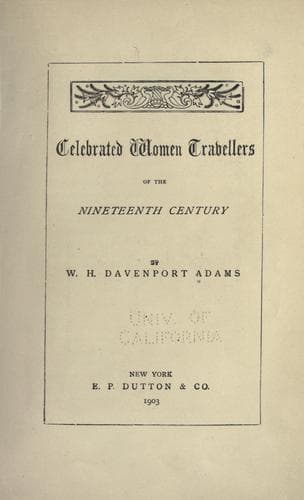
Celebrated Women Travellers of the Nineteenth CenturyAdams, W. H. Davenport (William Henry Davenport)
History
Celebrated Women Travellers of the Nineteenth Century
Adams, W. H. Davenport (William Henry Davenport)
Women travelers -- Biography
Her tastes for literary pursuits she has herself ascribed to the extreme
delicacy of her health in childhood; to the infirmity of deafness,
which, while not so complete as to debar her from all social
intercourse, yet compelled her to seek occupations and pleasures not
dependent upon others; and to the affection which subsisted between her
and the brother nearest her own age, the Rev. James Martineau, so well
known for his fine intellectual powers. The death of the father having
involved the family in the discomfort of narrow circumstances, the pen
she had hitherto wielded for amusement she took up with the view of
gaining an independent livelihood; and she conceived the idea of
employing fiction as a vehicle for the exposition and popularization of
the principles of social and political economy. The idea was as new as
it was happy; nor could it have been realized at a more opportune time
than when the English public was beginning to awake from its long
political lethargy, and to assert the rights of the nation against the
dominant class interests. It was desirable that its new-born activity
should be guided by an intelligent apprehension of the cardinal truths
by which reform is differentiated from revolution; and to contribute to
this result became Harriet Martineau's purpose. Accordingly, in 1826,
she wrote, and after conquering the difficulty of finding a publisher,
gave to the world her tale of "The Rioters," the first of a long series
of illustrations of political economy, which had a very considerable
influence, if not quite so great an influence, as she herself supposed.
The series comprises eighteen tales, of which the best, perhaps, are
"Ella of Gareloch," "Life in the Wilds," and "The Hamlets." Their true
merit consists in their having quickened and strengthened the interest
of the reading classes in economic questions. In their day they did an
useful work, but they are already forgotten; and, as Sara Coleridge
predicted, their political economy has proved too heavy a ballast for
vessels that were expected to sail down the stream of time.
Public-domain text, read in full here on John Shaqi.
Reviews
Reviews
No reviews yet
Be the first to share your thoughts on this work.
Elsewhere in the archive
Join the Discussion
Join the discussion
Sign in to leave a comment or review.
Sign InorCreate an account