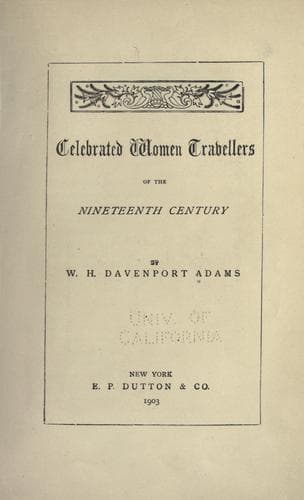
Celebrated Women Travellers of the Nineteenth CenturyAdams, W. H. Davenport (William Henry Davenport)
History
Celebrated Women Travellers of the Nineteenth Century
Adams, W. H. Davenport (William Henry Davenport)
Women travelers -- Biography
cabin for her accommodation, and without more ado she took up her
quarters on board the _Seignelay_, with no other escort or chaperonage
than that of the good bishop.
From Fiji the _Seignelay_ proceeded to Tonga, in the Friendly Islands,
where, in the usages of the population and in the insular antiquities,
Miss Cumming found much to interest her and her readers. As might be
expected, the old picturesqueness of the native life is fast
disappearing under the pressure of Western civilization, and we have
reason to be thankful to those travellers who do their best to catch its
waning features, and transfer them as faithfully as may be to the
printed page. The chief archaeological curiosities here are the tombs of
the old Tongan kings, cyclopean monuments built up of huge volcanic
blocks, which seem to have been brought from the Wallis group of islands
in open canoes, and erected on their present site with an immense
expenditure of human labour. Scarcely less remarkable is the great
solitary dolmen, which still exists intact, though of its origin nothing
is known, even in tradition. But that it marks the last resting-place of
some great chief or hero may be inferred from the fact that until within
the last few years an immense _Kana_ tent stood upon the transverse
capstone of the dolmen, and that feasts were celebrated on the spot. As
Miss Cumming reminds, similar celebrations take place in many parts of
Britain and Brittany "at the stones" to the present day.
From Tonga Miss Cumming was conveyed to Samoa, where she was very
hospitably received by the Samoan notables, and might have enjoyed
herself greatly, but for the civil war in which the group is always
plunged. It is to the credit of the inhabitants, however, that they
agree to abstain from fighting on at least one day of the week. In their
manners and customs they retain more of the primitive simplicity than is
found now-a-days in most of the Polynesian islands.
Public-domain text, read in full here on John Shaqi.
Reviews
Reviews
No reviews yet
Be the first to share your thoughts on this work.
Elsewhere in the archive
Join the Discussion
Join the discussion
Sign in to leave a comment or review.
Sign InorCreate an account