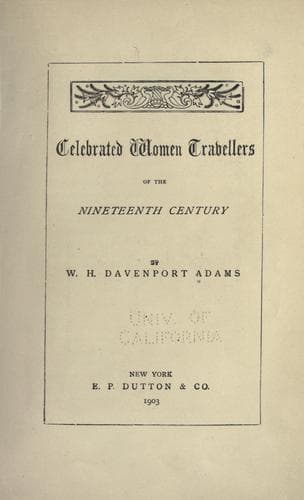
Celebrated Women Travellers of the Nineteenth CenturyAdams, W. H. Davenport (William Henry Davenport)
History
Celebrated Women Travellers of the Nineteenth Century
Adams, W. H. Davenport (William Henry Davenport)
Women travelers -- Biography
She was married at a very early age to a man much older than herself.
The ill-assorted union was as unhappy as such unions generally are. The
Baroness Axinia was beautiful, and drew around her a crowd of admirers,
whose flatteries she did not reject, though it does not appear that she
listened to professions of love which could have dishonoured her. In a
jealous frenzy, not unnatural in the circumstances, her husband struck
her with his dagger, and at the same time killed a young man whom for a
long time he had regarded as a friend. The result was an immediate
separation. The Baron settled upon her a considerable estate, and, in
addition, a handsome income. She had the consolation, moreover, of
being allowed to retain by her side the youngest of her daughters, and
thenceforth she resigned herself to a life of solitude, keeping hid
within her bosom the secret of her sorrow, her regret, and, perhaps, her
remorse.
Ten years passed, and the baroness never crossed the borders of her
estate. This self-imposed penance, so rigidly observed, may be accepted,
we think, as a sufficient acknowledgment of the errors of her
thoughtless youth.
"At our first interview," says Madame de Hell, "she seemed to me a
little timid, nay, even wild (_sauvage_)--a circumstance amply justified
by her exceptional position. But, in the course of a few days, this
constraint passed away, and a warm intimacy sprang up between us.
"From the first days of my visit, I remarked with lively surprise that
our hostess was incessantly assailed by a crowd of pretty tomtits, who
pecked at her hair and hands with truly extraordinary familiarity. The
baroness, after enjoying my astonishment, told me that two years before
she had brought up a couple of tomtits, and given them their liberty;
and that, in the following year, the couple returned with their brood,
who were easily taught to take their food from the hands of their
charming protectress. Other birds soon imitated their example, and thus
the beautiful solitary came to represent, undesignedly, one of the most
charming creations of Georges Sand, the bird-charmer, in her novel of
'Teverino.'"
In one of her walks with Madame de Hell, the baroness conducted her new
friend to the scene of the tragic drama which had broken up her life.
The house, entirely abandoned by the Baron, was inhabited only by a
Tartar, its guardian--a man of wild and gloomy aspect, whom the sight of
his mistress seemed to stupefy. While he was opening the doors and
windows, which had been kept closed since the fatal catastrophe, a
wretched half-starved looking dog, shivering in spite of the sunshine,
crawled out of a corner, the wonderful instinct of these animals having
made him conscious of the presence of his mistress. The latter,
overwhelmed with emotion, burst into tears: "Poor Salghir! poor
Salghir!" she cried, and was unable to utter another word.
Public-domain text, read in full here on John Shaqi.
Reviews
Reviews
No reviews yet
Be the first to share your thoughts on this work.
Elsewhere in the archive
Join the Discussion
Join the discussion
Sign in to leave a comment or review.
Sign InorCreate an account