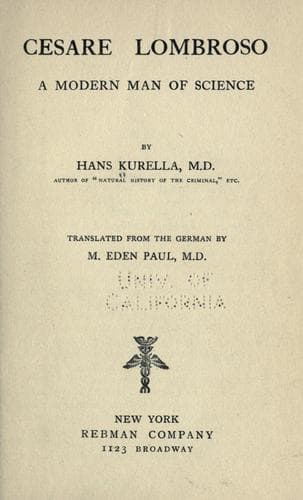
There was a very powerful subjective reason why Lombroso did not apply a
strenuous criticism to the occult phenomena of Eusapia, of Pickmann,
etc. His own most important ideas had at first encountered doubt from
the learned world, and in many cases contempt and ridicule. For this
reason he was free from the tendency, traditional in academic circles,
towards an extreme reserve in relation to completely new facts and
theories contrary to the dominant views, and therefore dangerous to
those advocating them. On the contrary, to doubt the good faith of those
who were producing the new hypnotic and other mediumistic phenomena was
not only contrary to his natural disposition, incapable of any pettiness
and indisposed to mistrust anything that was unusual, but it also
conflicted with the tendencies resulting from his own personal
experiences.
In the year 1872, when he brought before the Medical Academy of Milan
his experiments and investigations regarding the etiology of pellagra
through the consumption of spoilt maize, he was accused by the surgeon
Porta, Dean of the medical faculty of Pavia and an advocate of the
interests of the great landlords, of having falsified his experiments,
and of having artificially induced lesions in the animals he
experimented on—the result being that the whole matter was turned to
ridicule, and he and his pellagrous chickens were made fun of at the
next carnival.
Lombroso was accustomed to quote a verse from Dante, “Io non piangea, si
dentro impetrai” (“I did not weep, but my heart was turned to stone”),
in order to explain the impression left upon him by this experience. The
controversies about pellagra continued for about thirty years, until at
length, in the year 1902, official recognition was given to his theory
by the legislation carried in that year for the prevention of the
disease.[52] The _déclassé_, the Jew, the self-taught man, could not be
allowed to take an equal rank in the university life amongst the sons of
the well-to-do classes of Northern Italy, so closely allied with the
landed interest; and for this reason the most distinguished and
influential member of the academic circle described his laborious and
tedious researches as falsified. It was this experience which made it
psychologically impossible for him, when he came to study occult
phenomena, to take into consideration the possibility of fraud.
This helps us to understand how he came to enter upon these
investigations, and how it was that he allowed himself in many cases to
be deceived regarding the reality of the processes under observation.
Public-domain text, read in full here on John Shaqi.
Reviews
Reviews
No reviews yet
Be the first to share your thoughts on this work.
Elsewhere in the archive
Join the Discussion
Join the discussion
Sign in to leave a comment or review.
Sign InorCreate an account