Domestic fiction; England -- Social life and customs -- 19th century -- Fiction; Family -- England -- Fiction
The regaining of esteem and self-respect was lessening Clarence’s
bashfulness, and bringing out his powers of conversation, so that he
began to be appreciated as a pleasant companion, answering Griff’s
raillery in like fashion, and holding his own in good-natured repartee.
Mr. Fordyce got on excellently with him in their tête-à-têtes (who would
not with Parson Frank?), and held him in higher estimation than did
Ellen. To her, honesty was common, tame, and uninteresting in comparison
with heroism; and Griff’s vague statement that Clarence was the best
brother in the world did not go for much. Emily and I longed to get the
two better acquainted, but it did not become possible while Griff
absorbed the maiden as his exclusive property.
The engagement was treated as an avowed and settled thing, though I do
not know that there had been a formal ratification by the parents; but in
truth Mrs. Fordyce must have tacitly yielded her consent when she
permitted her daughter to make the journey under the guardianship of
Parson Frank. After a walk in the ravine of Lynton, we became aware of a
ring upon Ellen’s finger; and Emily was allowed at night to hear how and
when it had been put on.
Ellen only slightly deepened her lovely carnation tints when her father
indulged in a little tender teasing and lamentation over himself. She
was thoroughly happy and proud of her hero, and not ashamed of owning it.
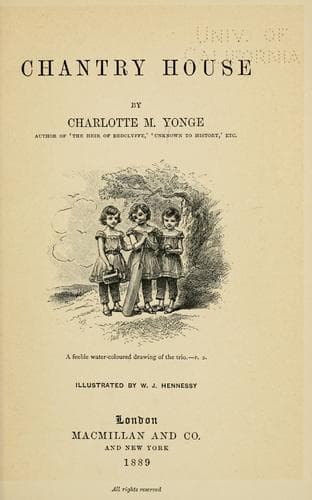
There was one evening when she and I were sitting with our sketchbooks in
the shade on the beech at Ilfracombe, while the rest had gone, some to
bathe, the others to make purchases in the town. We had been condoling
with one another over the impossibility of finding anything among our
water-colours that would express the wondrous tints before our eyes.
‘No, nothing can do it,’ I said at last; ‘we can only make a sort of blot
to assist our memories.’
‘Sunshine outside and in!’ said Ellen. ‘The memory of such days as these
can never fade away,—no, nor thankfulness for them, I hope.’
Something then passed about the fact that it was quite possible to go on
in complete content in a quiet monotonous life, in an oyster-like way,
till suddenly there was an unveiling and opening of unimagined capacities
of enjoyment—as by a scene like this before us, by a great poem, an
oratorio, or, as I supposed, by Niagara or the Alps. Ellen put it—‘Oh!
and by feelings for the great and good!’ Dear girl, her colour deepened,
and I am sure she meant her bliss in her connection with her hero.
Presently, however, she passed on to saying how such revelations of
unsuspected powers of enjoyment helped one to enter into what was meant
by ‘Eye hath not seen, nor ear heard, neither hath it entered into the
heart of man to conceive, the things that God hath prepared for them that
love him.’ Then there was a silence, and an inevitable quoting of the
_Christian Year_, the guide to all our best thoughts—
‘But patience, there may come a time.’
Public-domain text, read in full here on John Shaqi.
Reviews
Reviews
No reviews yet
Be the first to share your thoughts on this work.
Elsewhere in the archive
Join the Discussion
Join the discussion
Sign in to leave a comment or review.
Sign InorCreate an account