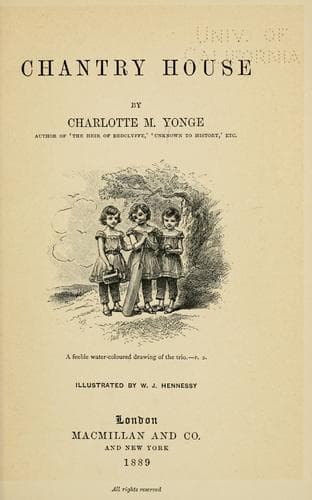
Domestic fiction; England -- Social life and customs -- 19th century -- Fiction; Family -- England -- Fiction
Poor Emily! It was in mingled grief and gladness that she set off the
next day, with the trepidation of one to whom sickness and decay were
hitherto unknown. When she returned, it was in a different mood, unable
to believe the doctors could be right, and in the delight of having her
own bright, sweet Ellen back again, all herself. They had talked, but
more of home and village than of foreign experiences; and though Ellen
did not herself assist, she had much enjoyed watching the unpacking of
the numerous gifts which had cost a perfect fortune at the Custom House.
No one seemed forgotten—villagers, children, servants, friends. Some of
these tokens are before me still. The Florentine mosaic paper-weight she
brought me presses this very sheet; the antique lamp she gave my father
is on the mantelpiece; Clarence’s engraving of Raffaelle’s St. Michael
hangs opposite to me on the wall. Most precious in our eyes was the
collection of plants, dried and labelled by herself, which she brought to
Emily and me—poor mummies now, but redolent of undying affection. Her
desire was to bestow all her keepsakes with her own hands, and in most
cases she actually did so—a few daily, as her strength served her. The
little figures in costume, coloured prints, Swiss carvings, French
knicknacks, are preserved in many a Hillside cottage as treasured relics
of ‘our young lady.’ Many years later, Martyn recognised a Hillside
native in a back street in London by a little purple-blue picture of
Vesuvius, and thereby reached the soft spot in a nearly dried-up heart.
So bright and playful was the dear girl over all her old familiar
interests that we inexperienced beings believed not only that the wound
to her affections was healed, but that she either did not know or did not
realise the sentence that had been pronounced on her; but when this was
repeated to her mother, it was met by a sad smile and the reply that we
only saw her in her best hours. Still, through the summer, it was
impossible to us to accept the truth; she looked so lovely, was so
cheerful, and took such delight in all that was about her.
With the first cold, however, she seemed to shrivel up, and the bad
nights extended into the days. Emily ascribed the change to the lack of
going out into the air, and always found reasons for the increased
languor and weakness; till at last there came a day when my poor little
sister seemed as if the truth had broken upon her for the first time,
when Ellen talked plainly to her of their parting, and had asked us both,
‘her dear brother and sister,’ to be with her at her Communion on All
Saints’ Day.
Public-domain text, read in full here on John Shaqi.
Reviews
Reviews
No reviews yet
Be the first to share your thoughts on this work.
Elsewhere in the archive
Join the Discussion
Join the discussion
Sign in to leave a comment or review.
Sign InorCreate an account