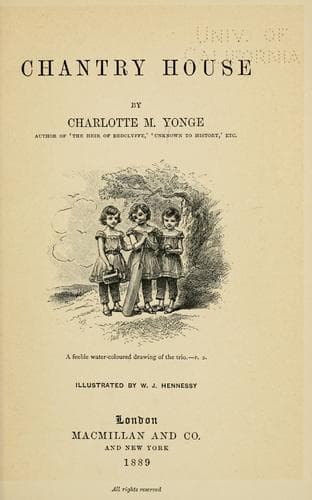
Domestic fiction; England -- Social life and customs -- 19th century -- Fiction; Family -- England -- Fiction
Why should I speak of such things here, except to mourn over our
much-loved brother, with all his fine qualities and powers wasted and
overthrown? He clung to Clarence’s affection, and submitted to prayers
and psalms, but without response. He showed tender recollection of us
all, but scarcely durst think of his father, and hardly appeared to wish
to see his mother. Clarence’s object soon came to be to obtain
forgiveness for the wife, since bitterness against her seemed the great
obstacle to seeking pardon, peace, or hope; but each attempt only
produced such bitterness against her, and such regrets and mourning for
Ellen, as fearfully shook the failing frame, while he moaned forth
complaints of the blandishments and raillery with which his temptress had
beguiled him. Clarence tried in vain to turn away this idea, but nothing
had any effect till he bethought himself of Ellen’s message, that she
knew even this fatal act had been prompted by generosity of spirit.
There was truth enough in it to touch Griff, but only so far as to cry,
‘What might I not have been with her?’ Still, there was no real
softening till my mother came. He knew her at once, and all the old
childish relations were renewed between them. There was little time left
now, but he was wholly hers. Even Clarence was almost set aside, save
where strength was needed, and the mother seemed to have equal control of
spirit and body. It was she, who, scarcely aware of what had gone
before, caused him to admit Selina.
‘Tell her not to talk,’ he said. ‘But we have each much to forgive one
another.’
She came in, awed and silent, and he let her kiss him, sit near at hand,
and wait on my mother, whose coming had, as it were, insensibly taken the
bitterness away and made him as a little child in her hands. He could
follow prayers in which she led him, as he could not, or did not seem to
do, with any one else, for he was never conscious of the presence of the
clergyman whom Thomson hunted up and brought, and who prayed aloud with
Martyn while the physical agony claimed both my mother and Clarence.
Once Griff looked about him and called out for our father, then
recollecting, muttered, ‘No—the birthright gone—no blessing.’
It grieved us much, it grieves me now, that this was his last distinct
utterance. He _looked_ as if the comforting replies and the appeals to
the Source of all redemption did awaken a response, but he never spoke
articulately again; and only thirty-six hours after my mother’s arrival,
all was over.
Poor Selina went into passions of hysterics and transports of grief,
needing all the firmness of so resolute a woman as my mother to deal with
her. She was wild in self-accusation, and became so ill that the care of
her was a not unwholesome occupation for my mother, who was one of those
with whom sorrow has little immediate outlet, and is therefore the more
enduring.
Public-domain text, read in full here on John Shaqi.
Reviews
Reviews
No reviews yet
Be the first to share your thoughts on this work.
Elsewhere in the archive
Join the Discussion
Join the discussion
Sign in to leave a comment or review.
Sign InorCreate an account