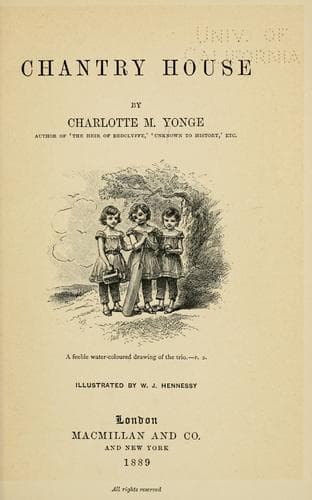
Domestic fiction; England -- Social life and customs -- 19th century -- Fiction; Family -- England -- Fiction
‘Is he going to wed a fair Chinese with lily feet?’ asked Martyn, to
which the reply was an unusually discourteous ‘Bosh,’ as Clarence escaped
with his letter. He was so reticent about it that I required a solemn
assurance that poor Lawrence’s head had not been turned by his fortune,
and that there was nothing wrong with him. Indeed, there was great
stupidity in never guessing the purport of that thick letter, nor that it
contained one for Emily, where Lawrence Frith laid himself, and all that
he had, at her feet, ascribing to her all the resolution with which he
had kept from evil, and entreating permission to come home and endeavour
to win her heart. We lived so constantly together that it is surprising
that Clarence contrived to give the letter to Emily in private. She
implored him to say nothing to us, and brought him the next day her
letter of uncompromising refusal.
He asked whether it would have been the same if he had intended to remain
at home.
‘As if you were a woman, you conceited fellow,’ was all the answer she
vouchsafed him.
Nor could he ascertain, nor perhaps would she herself examine, on which
side lay her heart of hearts. The proof had come whether she would abide
by her pledge to him to accept the care of us in his absence. When he
asked it, it had not occurred to him that it might be a renunciation of
marriage. Now he perceived that so it had been, but she kept her counsel
and so did he. We others never guessed at what was going on between
those two.
CHAPTER XLIV.
PAYING THE COST.
‘But oh! the difference to me.’
WORDSWORTH.
SO Clarence was gone, and our new life begun in its changed aspect.
Emily showed an almost feverish eagerness to make it busy and cheerful,
getting up a sewing class in the village, resuming the study of Greek,
grappling with the natural system in botany, all of which had been
fitfully proposed but hindered by interruptions and my father’s
feebleness.
On a suggestion of Mr. Stafford’s, we set to work on that _History of
Letter Writing_ which, what with collecting materials, and making
translations, lasted us three years altogether, and was a great resource
and pleasure, besides ultimately bringing in a fraction towards the great
purpose. Emily has confessed that she worked away a good deal of vague,
weary depression, and sense of monotony into those Greek choruses: but to
us she was always a sunbeam, with her ever ready attention, and the
playfulness which resumed more of genuine mirth after the first effort
and strain of spirits were over.
Then journal-letters on either side began to bridge the gulf of
separation,—those which, minus all the specially interesting portions,
are to be seen in the volume we culled from them, and which had
considerable success in its day.
Public-domain text, read in full here on John Shaqi.
Reviews
Reviews
No reviews yet
Be the first to share your thoughts on this work.
Elsewhere in the archive
Join the Discussion
Join the discussion
Sign in to leave a comment or review.
Sign InorCreate an account